So, here's an unpleasant truth about art: if you want to make any money with it, you have to work.
Like real work - all nighters, hard labor, and marketing.
I'm lucky that I know where to market my cooky webseries, The Adv. of Keith Flippen, and that is at sci-fi cons. It's great. I get to go to big nerd events and talk about something I love with other people who may be interested.
Let's face it. Keith Flippen isn't everyone's cup of tea. But, it is a very specific cup of tea, and I can work with that.
Wizard World NOLA won't be the first Con I've worked. Or second. Or even the first Con with Keith Flippen. But, Wizard World NOLA will be the biggest, and perhaps, most important to the series.
But working a Con isn't all fun in games. In fact, it's quite tiring. You spend a solid day, with no breaks, talking, promoting, informing, meeting, and socializing with every person you can. Now, we're going to be selling, which is another can of worms. There will be taxes to pay, and books to keep, and deal making. Not only do I have to be filmmaker and fan, but I have to be a business lady.
First and foremost, I'm hoping to achieve exposure. We have reached the end of our limited network, and it's time to expand. Videos can't go viral without views. This is a great opportunity to bring Keith Flippen to a larger local audience. And a larger audience will only benefit the show long term.
My second goal, is to try to bring in some much needed capital by selling merch. The awesome guest speakers at Web Weekend said web series make money in three different ways: advertisement (only happens with high numbers), sponsorship (again, a high number investment), or merchandise. We firmly fall into the merchandise category. While ad revenue and sponsorship may be something available to use down the road, we're really going to make money off selling stuff.
Creating merch is a whole other aspect of a working filmmaker that people don't consider. I had to figure out the cost of printing DVDs and Blu-Rays. Figure out what the hell we could reasonably sell. What would sell. And what we could afford to make. Find money for shirts, shot glasses, and stickers. (All these things costs money, on top of the money we spend securing a table, electrics, and passes at the con.) I had to figure out how much we need to sell to break even, how much to sell to to make money, and how much money before we cry.
This is another reasons Cons are such a great fit for us. It's gives us an avenue to sell our merch.
Why do we need to make money?
The Adv. of Keith Flippen cost roughly $10,000 to make. Without paying anyone. And not counting merchandise. Or any marketing. To continue, we're need find a way to support it. Yes, we are planning on using grant money. And yes, if it looks feasible, we will do another Kickstarter campaign. However, I do not have unrealistic expectations for how much money we can raise though those two avenues. And according to my calculations, I'll only be able to raise half the cost of season 2.
This does not mean the end of Keith Flippen. But, things like Wizard World hold the key to our success. So, if you're coming to Wizard World, stop buy our booth. Say hi. Tweet about seeing us, and buy something. Support the Adventure!
This is a blog where I share my experiences in art, specifically that of writing and filmmaking.
Wednesday, February 5, 2014
Friday, January 31, 2014
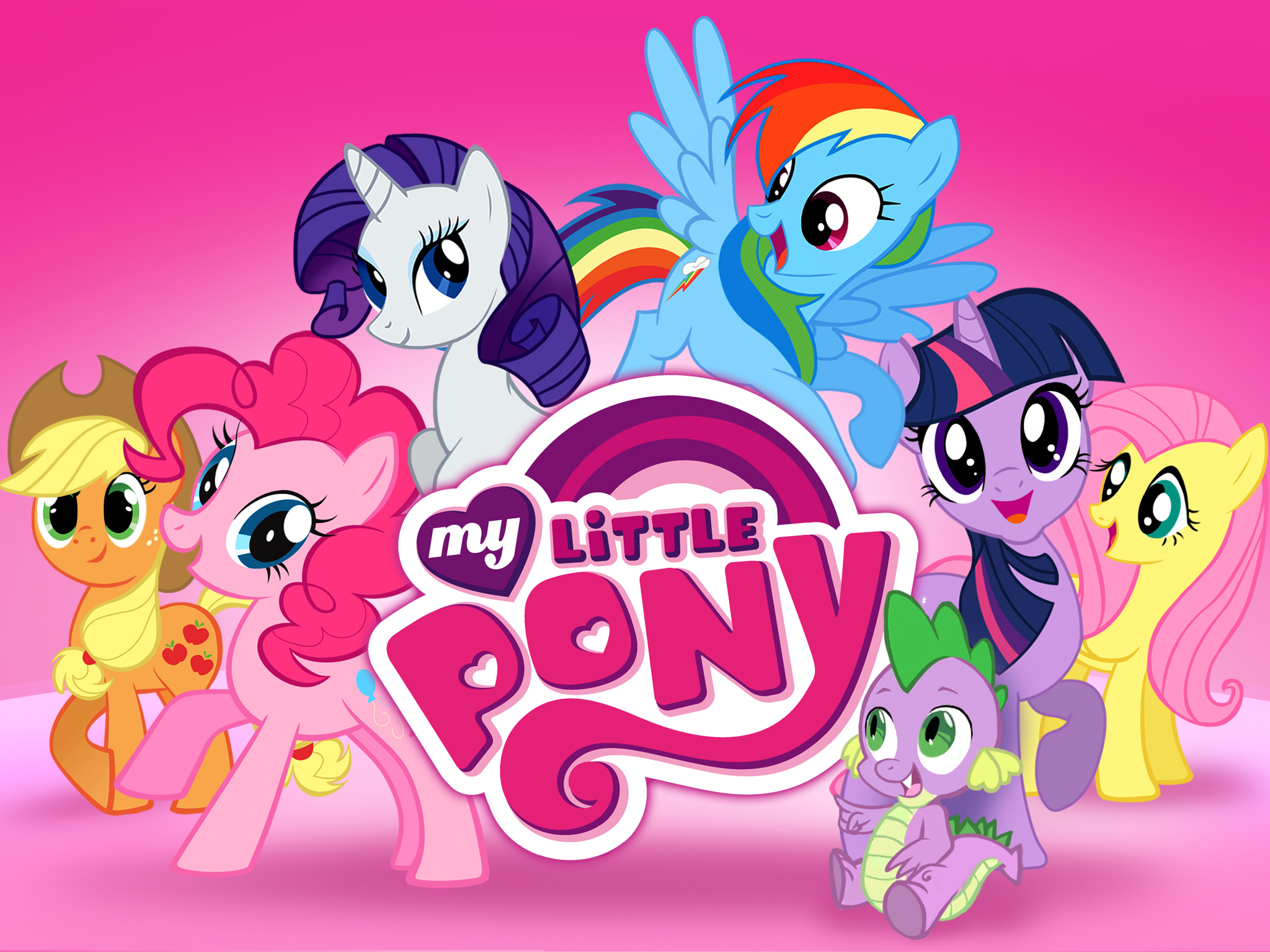
Bronies: The Perfect Look at Unexpected and Unaccepted Subculture
So, I watched the documentary Bronies: The Extremely Unexpected Adult Fan of My Little Pony. It's a good flick. There's nothing groundbreaking in it. Yet, maybe I'm wrong. It's a film that's goal is to demystify a subculture that is discriminated against. And I realized, that it brings to light so many issues that I have problems with in our society.
I have watched My Little Ponies: Friendship is Magic. At least, everything available on Netflix. I wouldn't call myself a Brony, but, I enjoyed it. It's a surprisingly solid show. I'd been intrigued by the design, and then the rumors about how good it is, which lead me to sitting down and powering through it. It left me pleasantly surprised. The show is all around excellent. The animation is unique and quite good. The voice acting is spot on. But, it's the writing that carries it. It's very well written, and not just for a kid show. In fact, it's the "kid show" moral lessons that can often hold it back. Even so, the morals are often well worked into the episode so they don't come across as preachy.
In the end, a combination of excellent marketability and good TV makes MLP a runaway success. It's not surprising to me that it would develop a fandom. The backlash against the fandom isn't really that surprising, either. Fandoms have been criticized for years, be it anime or Superman or Star Trek. Though, many, more mainstream, fandoms have become accepted, it seems that the haters have moved onto this one. But, this fandom is pretty unique to a younger generation, and in the age of "bullying," it makes sense that the fans would want to defend themselves. (Also, I can see why John de Lanzi would rally to its cause.)
One of the most interesting things about Bronies is it shows fan culture in a positive light. Whenever I would tease a friend or describe someone as a Brony, I never intended it in a negative way. To me, a Brony is a lighthearted person who was proud to wear a Rainbow Dash hoodie, and was generally above average in intelligence, and probably in his early to mid twenties. My kind of people. I never once though of a Brony being a pedophile, or a creepy guy living in his mom's basement.
A lighthearted person, who is proud to wear a graphic tee of their favorite kids' show, who's smart, and happy describes just about any fan boy or girl. Fandom is about a group of people sharing their love and joy for a single artistic project, be that a book, movie, TV show, or video game. It's an accepting culture, that embraces everyone's differences, because everyone involved in a little bit different too. And there should be no shame in that. We don't shame someone who listens to the Beatles all the time. Or goes to the movie and is a basement critic. Why should we shame someone who goes on to create fan work? Or makes new friends because of a common interest?
Most conventions are happy places full of oddballs who all share in the joy of being oddballs together. And that's what I love about it. Even if I'm not really a fangirl myself. It's a great film to watch for someone who's never been to an Con, and to help understand what goes on there better. And that's what I enjoyed about Bronies.
But Bronies is more than showing a fun and loving community. It goes through a list of reasons why we shouldn't be so against the subculture. And their list falls in line with certain ideals I have.
The first is the idea that children's things are less. So, a lot of backlash comes from the fact that this is a children's show. It's marketed to young girls. Not to the family. Nope, straight up kids. The show wasn't designed to please parents and children alike, like many successful animated films. It's a show with nothing but kids in mind. But, the show doesn't talk down to kids. Nor, does it create sub-par work because of its demographic. Yet, as a society, we somehow think that because it's target audience is youth, it's less important, less valuable, less influential than something for adults.
I HATE this antiquated, Victorian, bullshitty line of thinking. It boils down to the belief that children are lesser than adults. Children are humans too! And last time I checked, they can feel all the emotions an adult can, if not more because they haven't been jaded. Our first feelings are our strongest, otherwise, we would all forget our first love or the first time we lost someone dear. Children are observant and smart and capable of drawing conclusions about the world around them. Dumbing down content for children is stupid. And the assumption that all things are dumbed down so that "kids" can understand them is equally stupid.
Look at children's literature. We have complex and compelling stories for all ages. The Giver, The Hunger Games, The Fault in Our Stars, etc. Children's films work the same way. Look at Up, Finding Nemo, or really any Pixar film. You can't tell me that's not just as complex and compelling at most movies aimed just to adults. This prejudice against children's things exists in all art forms, and frankly I'm sick of it. What we enjoy as youth has just as much impact on our adult lives, if not more, than what we enjoy as adults. Come one, I bet you can remember your favorite show as a kid better and with more fondness than your favorite show from five years ago.
But back to the Bronies doc.
Not only are Bronies "weird" for liking children's things, but it's particularly bad because they're men interested in Girl things. Excuse me? I think that may be the most chauvinistic, back ass comment about the subculture so far! Because the content is feminine, because it features primarily female characters dealing with problems often associated as "womens problems," it's not acceptable for men to watch this. Bullshit. This is just something where feminism dies a little. And don't pretend that the animosity towards Bronies isn't a gender roles thing.
The popularity could come from the fact that the show has just the right mix of adventure and empathy. The documentary even goes into what the show excels at. And those things are genderless. (Though Bronies never comes out and says this, it is implied.) The fact that there are well rounded female characters in almost all roles doesn't mean that only girls can like them. A good character is a good character regardless of sex. (It just happens that there are less female good characters.) Just like children, women are human. We all have the same feelings, regardless of gender.
Yet, nay-sayers complain that MLP can't be a good show, or a show worthy of devotion because it's a LITTLE GIRLS' SHOW. Throughout the doc, the show is repeated described as a show for young girls, little girls. Not children. GIRLS. And that somehow makes it worse. If it were a pirate show geared towards young boys, I guarantee there wouldn't be as much backlash. But it's not. Society views a show aimed at girls to be even less than a show geared at boys. And that is repulsive.
In fact, I think the majority of the backlash against the community comes from the gender issue. It's the unexpected "male" community. It's the fact that grown men are watching, though there are many women who enjoy the show, that seems to be more accepted. The boy issues doesn't particularly surprise me since most fandoms are predominately male. Though, when you read about the Brony subculture, they seem to dance around it.
To me, this just means that there is a generation of young men growing up not viewing women as different, just as human, or pony, and that is something we should be happier about. (And not to forget the Pegasisters, girls who can enjoy unconventional, well rounded female characters.)
The show left me pondering subcultures in general. Wondering about how society views fandoms, and how wrong that is. And at some point I'll have to look at the contrasting gender dynamics in fandoms (strong female characters, but women can't be "geeks"). In the end, it ended up being a very insightful hour and a half of my life, and a doc that I would tell all my friends to watch.
I have watched My Little Ponies: Friendship is Magic. At least, everything available on Netflix. I wouldn't call myself a Brony, but, I enjoyed it. It's a surprisingly solid show. I'd been intrigued by the design, and then the rumors about how good it is, which lead me to sitting down and powering through it. It left me pleasantly surprised. The show is all around excellent. The animation is unique and quite good. The voice acting is spot on. But, it's the writing that carries it. It's very well written, and not just for a kid show. In fact, it's the "kid show" moral lessons that can often hold it back. Even so, the morals are often well worked into the episode so they don't come across as preachy.
In the end, a combination of excellent marketability and good TV makes MLP a runaway success. It's not surprising to me that it would develop a fandom. The backlash against the fandom isn't really that surprising, either. Fandoms have been criticized for years, be it anime or Superman or Star Trek. Though, many, more mainstream, fandoms have become accepted, it seems that the haters have moved onto this one. But, this fandom is pretty unique to a younger generation, and in the age of "bullying," it makes sense that the fans would want to defend themselves. (Also, I can see why John de Lanzi would rally to its cause.)
One of the most interesting things about Bronies is it shows fan culture in a positive light. Whenever I would tease a friend or describe someone as a Brony, I never intended it in a negative way. To me, a Brony is a lighthearted person who was proud to wear a Rainbow Dash hoodie, and was generally above average in intelligence, and probably in his early to mid twenties. My kind of people. I never once though of a Brony being a pedophile, or a creepy guy living in his mom's basement.
A lighthearted person, who is proud to wear a graphic tee of their favorite kids' show, who's smart, and happy describes just about any fan boy or girl. Fandom is about a group of people sharing their love and joy for a single artistic project, be that a book, movie, TV show, or video game. It's an accepting culture, that embraces everyone's differences, because everyone involved in a little bit different too. And there should be no shame in that. We don't shame someone who listens to the Beatles all the time. Or goes to the movie and is a basement critic. Why should we shame someone who goes on to create fan work? Or makes new friends because of a common interest?
Most conventions are happy places full of oddballs who all share in the joy of being oddballs together. And that's what I love about it. Even if I'm not really a fangirl myself. It's a great film to watch for someone who's never been to an Con, and to help understand what goes on there better. And that's what I enjoyed about Bronies.
The first is the idea that children's things are less. So, a lot of backlash comes from the fact that this is a children's show. It's marketed to young girls. Not to the family. Nope, straight up kids. The show wasn't designed to please parents and children alike, like many successful animated films. It's a show with nothing but kids in mind. But, the show doesn't talk down to kids. Nor, does it create sub-par work because of its demographic. Yet, as a society, we somehow think that because it's target audience is youth, it's less important, less valuable, less influential than something for adults.
I HATE this antiquated, Victorian, bullshitty line of thinking. It boils down to the belief that children are lesser than adults. Children are humans too! And last time I checked, they can feel all the emotions an adult can, if not more because they haven't been jaded. Our first feelings are our strongest, otherwise, we would all forget our first love or the first time we lost someone dear. Children are observant and smart and capable of drawing conclusions about the world around them. Dumbing down content for children is stupid. And the assumption that all things are dumbed down so that "kids" can understand them is equally stupid.
Look at children's literature. We have complex and compelling stories for all ages. The Giver, The Hunger Games, The Fault in Our Stars, etc. Children's films work the same way. Look at Up, Finding Nemo, or really any Pixar film. You can't tell me that's not just as complex and compelling at most movies aimed just to adults. This prejudice against children's things exists in all art forms, and frankly I'm sick of it. What we enjoy as youth has just as much impact on our adult lives, if not more, than what we enjoy as adults. Come one, I bet you can remember your favorite show as a kid better and with more fondness than your favorite show from five years ago.
But back to the Bronies doc.
Not only are Bronies "weird" for liking children's things, but it's particularly bad because they're men interested in Girl things. Excuse me? I think that may be the most chauvinistic, back ass comment about the subculture so far! Because the content is feminine, because it features primarily female characters dealing with problems often associated as "womens problems," it's not acceptable for men to watch this. Bullshit. This is just something where feminism dies a little. And don't pretend that the animosity towards Bronies isn't a gender roles thing.
The popularity could come from the fact that the show has just the right mix of adventure and empathy. The documentary even goes into what the show excels at. And those things are genderless. (Though Bronies never comes out and says this, it is implied.) The fact that there are well rounded female characters in almost all roles doesn't mean that only girls can like them. A good character is a good character regardless of sex. (It just happens that there are less female good characters.) Just like children, women are human. We all have the same feelings, regardless of gender.
Yet, nay-sayers complain that MLP can't be a good show, or a show worthy of devotion because it's a LITTLE GIRLS' SHOW. Throughout the doc, the show is repeated described as a show for young girls, little girls. Not children. GIRLS. And that somehow makes it worse. If it were a pirate show geared towards young boys, I guarantee there wouldn't be as much backlash. But it's not. Society views a show aimed at girls to be even less than a show geared at boys. And that is repulsive.
In fact, I think the majority of the backlash against the community comes from the gender issue. It's the unexpected "male" community. It's the fact that grown men are watching, though there are many women who enjoy the show, that seems to be more accepted. The boy issues doesn't particularly surprise me since most fandoms are predominately male. Though, when you read about the Brony subculture, they seem to dance around it.
To me, this just means that there is a generation of young men growing up not viewing women as different, just as human, or pony, and that is something we should be happier about. (And not to forget the Pegasisters, girls who can enjoy unconventional, well rounded female characters.)
The show left me pondering subcultures in general. Wondering about how society views fandoms, and how wrong that is. And at some point I'll have to look at the contrasting gender dynamics in fandoms (strong female characters, but women can't be "geeks"). In the end, it ended up being a very insightful hour and a half of my life, and a doc that I would tell all my friends to watch.
Wednesday, January 22, 2014
A Crew of Women - Keith Flippen's Feminine Touch
So, here's an interesting fact about Keith Flippen. Nearly 53% of the crew consisted of women. It's something I'm tremendously proud of, but, not something that I think is recognized. Especially since the content of the show is very masculine.
The Ladies of Keith Flippen:
Writer, Director, Producer - Shannon Kitchens
Queen Calamitious/Fight Director - Shelly Johnson Rucker
Penelope - Rebeca Hollingsworth
Zombie "Latte" - Renee Suttles
Art Director, Associate Producer, Special Guest Star - Sarah Hutson
Associate Producer, Special Guest Star - Leigh Traverse
Guest Star - Lisa Smith
Camera Operator - Zylena Beck
Boom Operator/Post Sound - Jamie Doyle
Art Director/Make-Up - Ashley Osborne
Art Director - Colleen DiCosola
Costumes/Art Director - Hope Kitchens
Assistant Director/Art Director/Make-Up - Cheri Cerio
Make-Up - Julie Vader
Special Guest Make-Up - Danielle Huval
Production Assistant - Madison Hutson
Production Assistant - Madeline Trosclair
Production Assistant - Megan Ray\
Script Supervisor - Suzie Hudson
Assistant Editor - Selena Muhoberac
Episode 2 Choreographer - Caree Llawellyn
Twenty-one women worked on the production of this show. Women worked in every department, and were even department head and producers. The entire Art Department consisted of women.
I'm sure having all these ladies on the set impacted the show, if only in a very subtle way.
Yes, I know there is a masculine tone to the show. However, it passes the Bechdel Test. Yes, there are two named women: Calamitious and Penelope (or Calamitious an Kaizoku). Yes, they have a conversation together (it's like the 2nd scene in the series). And it's not about a man. It's about Calamitous nefarious plan to capture the plot device, and how she needs Penelope to do this. This is again repeated in episode two with Kaizoku.
I'm okay with the masculine tones. Besides, gender identity is something I like to play with. Like, the masculine expectations of Victory and Keith (and their almost romantic partnership). I like keeping Penelope smart and sexy (because I am firmly convinced, she is actually the smartest character on the show). The Professor borders on effeminate and is a homosexual character. Queen Calamitious is as brutal as she is beautiful.
There's an interesting story behind Queen Calamitious. In the original concept, she was a he. I made the call to change the character to a female because I had an actress in mind for the part. My co-writers were surprised at first, but during the pilot, there was no time to really account for the gender swap. So, her dialogue stayed very masculine. At the time, I didn't really know this.
When we started drafting the first season, I found her character changing. There was something different about her, and I couldn't quite place it. Her voice just wasn't the same. She was, for a lack of a better word, girly. I brought it up with my writers. They didn't understand at first. So, when I asked how they came up with the original voice, and they answered, well, it was male. My response was, "Then write her like a man."
The thought of gender making that much of an impact on character is baffling to me. It reminded me of something George R.R. Martin said:
I made a very interesting, and deliberate, choice by visually sexualizing my villain. She's a very pretty girl, yet, she never uses her femininity to get what she wants. Instead, she forces it with masculine violence and will. Her minions cower before her. She never uses sex as a means to get what she wants, nor, really any other female stereotypes. She's not lying nor deceitful. She's not quite or submissive. She's not maternal nor girlfriend material. Really, the only stereotype I gave her was a sexy outfit. I wanted that dichotomy of visual femininity vs masculine actions. (And Shelly did an excellent job breathing in a regal air to the character, adding to her femininity, without using stereotypes.)
On the other hand, I worked very hard at pulling Penelope away from being a "girlfriend" troupe. And I'm lucky that Rebecca is such an amazing actress because I don't think I could have done that without her. Penelope is a sex object, that shows no interest in sex (unless its to her advantage). She constantly resists Victory's advances, and while "dumb blonde"-ish, she's an expert escape artist and a xenolinguistic. She also, is one of the best fighters in the series (I mean, come on, she's the only one who takes out any zombies during the final fight scene. She requires TWO zombies to take her down.)
Why am I bringing up all these gender roles and such for Keith Flippen? Probably because I am a woman in film. Because I get mad that my work gets written off because it's not about "girl issues."
Women are frequently kept away from heavier workloads on sets, often confined to make-up and costumes. And while women did do those roles on my set, it was a regular site to see three girl running around with large flats and power tools. Girls moving lights. Girls with boom poles. Girls behind the camera. And no one thinking anything of it.
So, I am super proud of my set, and all the women and men who worked their butts off to make the show what it is. And I hope to continue to work on sets that don't find it strange to see so many girls doing a traditionally "man's" job.
There's me rocking a dress on set talking business with my AD, while one of my kick-ass girl art directors gets the set dressed.
The Ladies of Keith Flippen:
Writer, Director, Producer - Shannon Kitchens
Queen Calamitious/Fight Director - Shelly Johnson Rucker
Penelope - Rebeca Hollingsworth
Zombie "Latte" - Renee Suttles
Art Director, Associate Producer, Special Guest Star - Sarah Hutson
Associate Producer, Special Guest Star - Leigh Traverse
Guest Star - Lisa Smith
Camera Operator - Zylena Beck
Boom Operator/Post Sound - Jamie Doyle
Art Director/Make-Up - Ashley Osborne
Art Director - Colleen DiCosola
Costumes/Art Director - Hope Kitchens
Assistant Director/Art Director/Make-Up - Cheri Cerio
Make-Up - Julie Vader
Special Guest Make-Up - Danielle Huval
Production Assistant - Madison Hutson
Production Assistant - Madeline Trosclair
Production Assistant - Megan Ray\
Script Supervisor - Suzie Hudson
Assistant Editor - Selena Muhoberac
Episode 2 Choreographer - Caree Llawellyn
Twenty-one women worked on the production of this show. Women worked in every department, and were even department head and producers. The entire Art Department consisted of women.
And here we have girls working cameras and mics.
I'm sure having all these ladies on the set impacted the show, if only in a very subtle way.
Yes, I know there is a masculine tone to the show. However, it passes the Bechdel Test. Yes, there are two named women: Calamitious and Penelope (or Calamitious an Kaizoku). Yes, they have a conversation together (it's like the 2nd scene in the series). And it's not about a man. It's about Calamitous nefarious plan to capture the plot device, and how she needs Penelope to do this. This is again repeated in episode two with Kaizoku.
I'm okay with the masculine tones. Besides, gender identity is something I like to play with. Like, the masculine expectations of Victory and Keith (and their almost romantic partnership). I like keeping Penelope smart and sexy (because I am firmly convinced, she is actually the smartest character on the show). The Professor borders on effeminate and is a homosexual character. Queen Calamitious is as brutal as she is beautiful.
There's an interesting story behind Queen Calamitious. In the original concept, she was a he. I made the call to change the character to a female because I had an actress in mind for the part. My co-writers were surprised at first, but during the pilot, there was no time to really account for the gender swap. So, her dialogue stayed very masculine. At the time, I didn't really know this.
When we started drafting the first season, I found her character changing. There was something different about her, and I couldn't quite place it. Her voice just wasn't the same. She was, for a lack of a better word, girly. I brought it up with my writers. They didn't understand at first. So, when I asked how they came up with the original voice, and they answered, well, it was male. My response was, "Then write her like a man."
The thought of gender making that much of an impact on character is baffling to me. It reminded me of something George R.R. Martin said:
I made a very interesting, and deliberate, choice by visually sexualizing my villain. She's a very pretty girl, yet, she never uses her femininity to get what she wants. Instead, she forces it with masculine violence and will. Her minions cower before her. She never uses sex as a means to get what she wants, nor, really any other female stereotypes. She's not lying nor deceitful. She's not quite or submissive. She's not maternal nor girlfriend material. Really, the only stereotype I gave her was a sexy outfit. I wanted that dichotomy of visual femininity vs masculine actions. (And Shelly did an excellent job breathing in a regal air to the character, adding to her femininity, without using stereotypes.)
On the other hand, I worked very hard at pulling Penelope away from being a "girlfriend" troupe. And I'm lucky that Rebecca is such an amazing actress because I don't think I could have done that without her. Penelope is a sex object, that shows no interest in sex (unless its to her advantage). She constantly resists Victory's advances, and while "dumb blonde"-ish, she's an expert escape artist and a xenolinguistic. She also, is one of the best fighters in the series (I mean, come on, she's the only one who takes out any zombies during the final fight scene. She requires TWO zombies to take her down.)
Why am I bringing up all these gender roles and such for Keith Flippen? Probably because I am a woman in film. Because I get mad that my work gets written off because it's not about "girl issues."
Women are frequently kept away from heavier workloads on sets, often confined to make-up and costumes. And while women did do those roles on my set, it was a regular site to see three girl running around with large flats and power tools. Girls moving lights. Girls with boom poles. Girls behind the camera. And no one thinking anything of it.
So, I am super proud of my set, and all the women and men who worked their butts off to make the show what it is. And I hope to continue to work on sets that don't find it strange to see so many girls doing a traditionally "man's" job.
Wednesday, January 15, 2014
The Purge, and the Biggest Reason It Failed
Last night I watched The Purge. It's a 2013 horror movie of little note. The summary: In a future America, one night a year all crime is legal, allowing for a catharsis of violence, and a reduction in crime the remainder of the year. Upper middle class, suburban, white family, headed by Ethan Hawke, has made a comfortable living selling security, and on the night of the annual Purge, feel safe. Of course, they're not. The youngest child, a son, decides to help a random man on the street. This invites the group of masked killers to pursue the family for harboring their victim. The once impenetrable home security that Ethan Hawke so proudly sold, is breached and the family must fight for their lives.
The concept of The Purge is quite interesting. One day of sanctioned crime. Any crime it seems, yet the movie restricts itself to murder. This, of course, would be the most frightening aspect of the night to a upper middle class white family. I, on the other hand, immediately thought of several other crimes that could make an interesting story.
Which brings me to why this movie failed. As you can tell from my summary, I can't even remember the characters names. I call the MC, Ethan Hawke, because that's really the only way I can identify him. His character is completely lackluster, and the rest of his household is filled with upper middle class white troupes. Rebellious and horny teen daughter. Slightly smarter than average, but maybe not because he makes so many dumb moves, son. And a wife. Whose sole purpose is wife and mother. She does not exist outside those roles.
Now, you may be thinking that I'm about to come to the conclusion that it's the lack of characterization that makes this movie awful. And while that certainly didn't help it, I don't think that's it. In fact, I think it's the setting.
We know very little about the Purge from the movie. There is a little bit of exposition, in that it seems to screw the lower class because they cannot afford protection. Also emergency services will be offline during the 12 hours the event takes place. No hospitals, no fire department, no police. Yet, at the end of the movie, as the clock strikes the hour of the end, police sirens are heard in the background. The other bit of info we know is that Ethan Hawke's character is quite wealthy, and lives in a gated community. Which is probably quite secure and not really affected by the Purge as other areas of the country. Then we are forced to follow this family, that is not a reflection at all of the majority of American families, who are basically victimized for "good deeds." I can't even say because they're kind (they're not). The good deed doesn't come from anywhere other than a means to advance the plot. Because, if they never allowed the man in, then there would be no movie. They're victimized because the plot calls for it.
However, if we took a the concept of the Purge, and set it just about anywhere else, the story becomes much more interesting.
What is the Purge like in one of those lower class families that can't afford protection? Do they join in so that they are not slaughtered? Or do they booby trap their house?
Also, murder is actually a fairly rare crime. Thief is much higher. So by this logic, wouldn't just a middle class family, or even a lower middle class family be worse off? They make just enough money to have nice things, so they have items worth stealing, but not enough money to have high end security. Seems to me that they would be the most targeted economic tier.
How about in a hospital? Just because the ER is closed, doesn't mean everyone in the hospital is kicked out. You could have doctors and patients going on rampages. Or people desperately trying to get in to get helped. Or people trying to steal pharmaceuticals. That seems like a terrifying place to be during this event.
Then there's emergency services. The sirens hit the roads as soon as the Purge ends. This means, that the police and fire departments have people waiting so that they can be dispatched at the end of the Purge. And of course, reporting to work during the Purge is deadly, so they are probably there all night. Yet, another more interesting story.
Besides emergency services, there are other companies that probably require employees to stay overnight during the Purge. There is a live television feed throughout the event. This means there's a TV station with employees working through the night. What about what happens to them? To have to work the most dangerous night of the year? Is the pay like quadrupled and worth it? Is it a Deadliest Catch deal? Or are they forced to or lose their job?
There's also humanitarians. What about churches? Red Cross? People who devote their lives to helping the poor? Are they out roaming the streets? Offering help to the wounded? Providing protection? What hells do they face?
In the credits, there's a brief report that 200 people in Austin participated in the Purge all at once in town square or whatever. THAT is a more interesting setting than what we got!
Why are these settings more interesting? Because the setting already has intrinsic conflict. If you are committing a crime, that's a conflict. If you cannot protect yourself because of economic status, conflict. If you are trapped somewhere, conflict. If you're stuck in a well secured, upper middle class house, well, the conflict has to come to you. And it didn't feel natural.
Personally, I would set the story in an office building. With a small group of friends trying to commit embezzlement. They could turn against each other, and then they have to fight over anyone else who may be in the building. Security? Others seeking shelter? Others out for the wild ride? My husband votes for the same story, but set in a lower middle class home. Embezzling, while trying to stay alive and guard your home.
Why did The Purge choose the setting it did? I think it's laziness. It's easy to write about a bland, upper middle class family. I'm sure the writer was trying to make a statement on how no one is safe, and that even the rich can be targeted. A statement that the person selling security isn't even secure. A statement about how we can't trust our neighbors. Plus, it's easier. It's easier than thinking up traps. It's easier than coming up with dynamic and unique characters, challenged to do something more. It's easy to think that the Purge is all about murder instead of the plethora of crime that would actually be going on.
I would like the write The Purge 2. Use this quite interesting concept, and really take it somewhere. Now, does anyone know those producers?
The concept of The Purge is quite interesting. One day of sanctioned crime. Any crime it seems, yet the movie restricts itself to murder. This, of course, would be the most frightening aspect of the night to a upper middle class white family. I, on the other hand, immediately thought of several other crimes that could make an interesting story.
Which brings me to why this movie failed. As you can tell from my summary, I can't even remember the characters names. I call the MC, Ethan Hawke, because that's really the only way I can identify him. His character is completely lackluster, and the rest of his household is filled with upper middle class white troupes. Rebellious and horny teen daughter. Slightly smarter than average, but maybe not because he makes so many dumb moves, son. And a wife. Whose sole purpose is wife and mother. She does not exist outside those roles.
Now, you may be thinking that I'm about to come to the conclusion that it's the lack of characterization that makes this movie awful. And while that certainly didn't help it, I don't think that's it. In fact, I think it's the setting.
We know very little about the Purge from the movie. There is a little bit of exposition, in that it seems to screw the lower class because they cannot afford protection. Also emergency services will be offline during the 12 hours the event takes place. No hospitals, no fire department, no police. Yet, at the end of the movie, as the clock strikes the hour of the end, police sirens are heard in the background. The other bit of info we know is that Ethan Hawke's character is quite wealthy, and lives in a gated community. Which is probably quite secure and not really affected by the Purge as other areas of the country. Then we are forced to follow this family, that is not a reflection at all of the majority of American families, who are basically victimized for "good deeds." I can't even say because they're kind (they're not). The good deed doesn't come from anywhere other than a means to advance the plot. Because, if they never allowed the man in, then there would be no movie. They're victimized because the plot calls for it.
However, if we took a the concept of the Purge, and set it just about anywhere else, the story becomes much more interesting.
What is the Purge like in one of those lower class families that can't afford protection? Do they join in so that they are not slaughtered? Or do they booby trap their house?
Also, murder is actually a fairly rare crime. Thief is much higher. So by this logic, wouldn't just a middle class family, or even a lower middle class family be worse off? They make just enough money to have nice things, so they have items worth stealing, but not enough money to have high end security. Seems to me that they would be the most targeted economic tier.
How about in a hospital? Just because the ER is closed, doesn't mean everyone in the hospital is kicked out. You could have doctors and patients going on rampages. Or people desperately trying to get in to get helped. Or people trying to steal pharmaceuticals. That seems like a terrifying place to be during this event.
Then there's emergency services. The sirens hit the roads as soon as the Purge ends. This means, that the police and fire departments have people waiting so that they can be dispatched at the end of the Purge. And of course, reporting to work during the Purge is deadly, so they are probably there all night. Yet, another more interesting story.
Besides emergency services, there are other companies that probably require employees to stay overnight during the Purge. There is a live television feed throughout the event. This means there's a TV station with employees working through the night. What about what happens to them? To have to work the most dangerous night of the year? Is the pay like quadrupled and worth it? Is it a Deadliest Catch deal? Or are they forced to or lose their job?
There's also humanitarians. What about churches? Red Cross? People who devote their lives to helping the poor? Are they out roaming the streets? Offering help to the wounded? Providing protection? What hells do they face?
In the credits, there's a brief report that 200 people in Austin participated in the Purge all at once in town square or whatever. THAT is a more interesting setting than what we got!
Why are these settings more interesting? Because the setting already has intrinsic conflict. If you are committing a crime, that's a conflict. If you cannot protect yourself because of economic status, conflict. If you are trapped somewhere, conflict. If you're stuck in a well secured, upper middle class house, well, the conflict has to come to you. And it didn't feel natural.
Personally, I would set the story in an office building. With a small group of friends trying to commit embezzlement. They could turn against each other, and then they have to fight over anyone else who may be in the building. Security? Others seeking shelter? Others out for the wild ride? My husband votes for the same story, but set in a lower middle class home. Embezzling, while trying to stay alive and guard your home.
Why did The Purge choose the setting it did? I think it's laziness. It's easy to write about a bland, upper middle class family. I'm sure the writer was trying to make a statement on how no one is safe, and that even the rich can be targeted. A statement that the person selling security isn't even secure. A statement about how we can't trust our neighbors. Plus, it's easier. It's easier than thinking up traps. It's easier than coming up with dynamic and unique characters, challenged to do something more. It's easy to think that the Purge is all about murder instead of the plethora of crime that would actually be going on.
I would like the write The Purge 2. Use this quite interesting concept, and really take it somewhere. Now, does anyone know those producers?
Wednesday, January 8, 2014
2013 - The Year of Keith Flippen
So, it has been a very long time since I posted. And that reason is simple: I made a Web Series.
For me, 2013 was the year of Keith Flippen. It literally took up my entire year.
In January, I remember wondering around Best Buy on the phone with one of my co-producers, discussing Kickstarter. I was at Best Buy because I think we'd gotten gift cards for Christmas. January was the month I began to take the project seriously. Our 48HFP was buzzing. Everyone involved wanted more. I knew that meant we had something on our hands.
February comes, and my co-producers and I put our heads together to build our Kickstarter campaign. We set a goal we thought we could make - $9,000. It was also the minimum we'd need to produce this beast. While our concept may be great, and our design very hockey, it still costs a chunk of money to produce anything of that scale. So we fretted, and tweaked, and come March, made it live.
The timing of our Kickstarter was deliberate. March and April was already packed with travel as we would be touring our Pilot at various festivals and Cons. Every weekend during the campaign, I was out busting my chops promoting, networking, and working. I had some amazing events, such as screening at The Chinese Theaters. And my birthday was smack in the middle, so I got some time to relax.
May meant pre-production. Finishing the scripts. Creating sets. Scheduling. All that stuff that comes before the camera rolls in order to things to be a smooth as possible. Of course, this wasn't without hiccups. Tempers ran high. Egos were hurt. People learned what they were made of. In the end, we had everything as ready as it could be for filming, more or less.
June and July was the main month of production. Four weeks, 23 hours a week, in the dead of Louisiana summer, in a warehouse with no AC, we filmed. And filmed. And filmed. We were pushed to extremes, and we had a great time. And amazingly, stayed on schedule. We didn't have to schedule additional filming days, and we rarely ran over. It was pretty magical, and something I'm damned proud of.
August was a bit of a break, but then we threw ourselves into post-production. Editing, music, effects. A seemingly endless amount of work and footage to comb through.
October brought our release. Additionally, we got to participate in NOVAC's Web Weekend and receive critical feedback from industry leaders, and promote ourselves at CONtraflow all the in the same weekend. Then we went live.
November and December meant the intensity was up as the post team struggled to keep up with the workload. I failed my Nanowrimo, but kept on schedule. My parents visited me for Christmas so I could keep working. I spent the evening of the 30, sitting at our music guy's house waiting for the final score to export. Which at least meant that I got to enjoy ringing in the New Year since Jan 1, 2014 marked the season finale.
For the last year, when ever someone asked what I was doing, my answer would be, "Working on Keith Flippen." Every free moment was spent working on the project. I've even started answering the questions "How are you doing?" with "Keith Flippen" because it's been a state of being for me.
The Adventures of Keith Flippen runs a few minutes shy of an hour, which puts it at feature film length. Meaning, for around $12,000 and a lot of gumption, in a year's time, I made a feature. That is an amazing feat. Something that I am quite proud of.
And while 2013 has ended, the world of Keith Flippen has not. I'm busy working through DVD production, and trying to rally the teams for Wizard World New Orleans. 2013 may have been the year of Keith Flippen, but I'd like to see 2014 the year everyone can't stop talking about it.
I'm not sure what the future holds for my show, but it holds a lot of me. I know I can do amazing things. And this year, I plan to. I have so many ideas for new web series, new short films, new feature films, new crafts, new everything. I'm ready to push forward, and I hope, that this year can only expand upon everything I've already built.
For anyone interested, you can watch the entire season now!
For me, 2013 was the year of Keith Flippen. It literally took up my entire year.
In January, I remember wondering around Best Buy on the phone with one of my co-producers, discussing Kickstarter. I was at Best Buy because I think we'd gotten gift cards for Christmas. January was the month I began to take the project seriously. Our 48HFP was buzzing. Everyone involved wanted more. I knew that meant we had something on our hands.
February comes, and my co-producers and I put our heads together to build our Kickstarter campaign. We set a goal we thought we could make - $9,000. It was also the minimum we'd need to produce this beast. While our concept may be great, and our design very hockey, it still costs a chunk of money to produce anything of that scale. So we fretted, and tweaked, and come March, made it live.
The timing of our Kickstarter was deliberate. March and April was already packed with travel as we would be touring our Pilot at various festivals and Cons. Every weekend during the campaign, I was out busting my chops promoting, networking, and working. I had some amazing events, such as screening at The Chinese Theaters. And my birthday was smack in the middle, so I got some time to relax.
May meant pre-production. Finishing the scripts. Creating sets. Scheduling. All that stuff that comes before the camera rolls in order to things to be a smooth as possible. Of course, this wasn't without hiccups. Tempers ran high. Egos were hurt. People learned what they were made of. In the end, we had everything as ready as it could be for filming, more or less.
June and July was the main month of production. Four weeks, 23 hours a week, in the dead of Louisiana summer, in a warehouse with no AC, we filmed. And filmed. And filmed. We were pushed to extremes, and we had a great time. And amazingly, stayed on schedule. We didn't have to schedule additional filming days, and we rarely ran over. It was pretty magical, and something I'm damned proud of.
August was a bit of a break, but then we threw ourselves into post-production. Editing, music, effects. A seemingly endless amount of work and footage to comb through.
October brought our release. Additionally, we got to participate in NOVAC's Web Weekend and receive critical feedback from industry leaders, and promote ourselves at CONtraflow all the in the same weekend. Then we went live.
November and December meant the intensity was up as the post team struggled to keep up with the workload. I failed my Nanowrimo, but kept on schedule. My parents visited me for Christmas so I could keep working. I spent the evening of the 30, sitting at our music guy's house waiting for the final score to export. Which at least meant that I got to enjoy ringing in the New Year since Jan 1, 2014 marked the season finale.
For the last year, when ever someone asked what I was doing, my answer would be, "Working on Keith Flippen." Every free moment was spent working on the project. I've even started answering the questions "How are you doing?" with "Keith Flippen" because it's been a state of being for me.
The Adventures of Keith Flippen runs a few minutes shy of an hour, which puts it at feature film length. Meaning, for around $12,000 and a lot of gumption, in a year's time, I made a feature. That is an amazing feat. Something that I am quite proud of.
And while 2013 has ended, the world of Keith Flippen has not. I'm busy working through DVD production, and trying to rally the teams for Wizard World New Orleans. 2013 may have been the year of Keith Flippen, but I'd like to see 2014 the year everyone can't stop talking about it.
I'm not sure what the future holds for my show, but it holds a lot of me. I know I can do amazing things. And this year, I plan to. I have so many ideas for new web series, new short films, new feature films, new crafts, new everything. I'm ready to push forward, and I hope, that this year can only expand upon everything I've already built.
For anyone interested, you can watch the entire season now!
Friday, March 1, 2013
Hello, and yes, I'm still alive.
Well, I've been meaning to get back to this for a while now. But, well, let's just say things have been quite busy. And this blog was a reminder of things of the past that I missed, and things that are changing.
It seems that 2012 was the end of the world for me. Because 2013 is certainly exploding with changes. There's something brewing in my life, and I feel that this is the year everything will change for the best.
I've been meaning to do a blog about how much I kept to my New Year's goals and what I plan to do this year. But alas, I didn't. I was too busy.
With what you say?
Remember that winning 48HFP? Well, it has a Kickstarter page now. Take a minute to check it out.
Most of my writing has been put on hold. I've poured my energies into The Adventures of Keith Flippen, and it's eaten all of my time.
(Most sadly of all I never got to finish my Sci-Fi Red Riding Hood Cape. Good thing there's still time for that.)
Anyway, I hope to keep this more updated. To those who've been following me, thank you. And consider spreading the word about Keith Flippen. It's going to be epic.
It seems that 2012 was the end of the world for me. Because 2013 is certainly exploding with changes. There's something brewing in my life, and I feel that this is the year everything will change for the best.
I've been meaning to do a blog about how much I kept to my New Year's goals and what I plan to do this year. But alas, I didn't. I was too busy.
With what you say?
Remember that winning 48HFP? Well, it has a Kickstarter page now. Take a minute to check it out.
Most of my writing has been put on hold. I've poured my energies into The Adventures of Keith Flippen, and it's eaten all of my time.
(Most sadly of all I never got to finish my Sci-Fi Red Riding Hood Cape. Good thing there's still time for that.)
Anyway, I hope to keep this more updated. To those who've been following me, thank you. And consider spreading the word about Keith Flippen. It's going to be epic.
Tuesday, October 2, 2012
Winner of the New Orleans 48HFP
So.... Besides this post being super late....
WE WON!!!!!!!!!!!!!!
Ahem.... So in my last post I talked about what I'd been up to, and one of those things was the 48HFP. Now I love 48. I've been competing for four years. I have a great team. We made a great film that we loved. But we never thought, in our wildest dreams, that this would happen.
We won 10 of the 17 awards*, including Best Overall. Which means, our cheese ball little sci-fi adventure serial will not only be shown at the New Orleans Film Festival (holy moly! And we're in Louisana Shorts 2 *cough*) but we'll be competing against all the best of's at Flimapalooza in Los Angeles! We have no expectations of winning, but are just excited to be grouped with the best of the best - to say, we were there among the greats. It's so amazing.
I am also personally honored because we won Best Director. I totally teared up when I heard my named called for that. I'm still stunned.
I also learned sooo much from this year's competition. I watched every film this year, finally being able to make it out to all the screenings. And I will say, that there were some really fabulous films. Makes it even more astonishing to us to be ranked with those other wonderful filmmakers.
This is my 4th year doing 48HFP, and every year I learn something about film making and myself. I learn how to do something, and take all the things I did wrong in the past and chuck them out the window so I can make new mistakes.
Which leads me to something I never thought I learned about 48: how to make a winning 48.
1. Don't make a film to win; make the film you want to make.
Long before there were even nominations for awards, my team and I were proud of our 8 minute flick. Why? Because no matter what happened, we loved our film. We were proud of it, and we never once thought about "winning" while we were making it.
So, Friday night I pulled the genre "romance," and cringed. We talked about genres to throw back, and romance didn't make the list. We weren't afraid of romance (we were afraid of drama), but we weren't enamored with it either. Kirk insisted I text the group and ask them if I should throw back the genre. It was unanomous. Throw it back. A romance was not the film we wanted to make. And I'm so glad we did, because our 2nd choice was what I pulled - Adventure Serial. I screamed yes! and high-fived Kirk, and drew the attention of every remaining team (probably wondering what we were so happy about).
We were so happy because we were going to make the film we wanted to make. And everyone on our team felt the same way. All the pieces floated together. Everyone was stoked. It was magical. And not once did we ever think about awards or winning. It didn't matter, and we didn't care.
We didn't make any choices for our film thinking, we might win this award if we did this. Winning never matter, though, we all admitted it would be really nice.
2. Don't let your equipment stop you.
Okay, I'll be the first to admit we have some decent equipment, and some crappy equipment. We're real middle of the road when it comes to that. SO MANY teams had fabulous equipment. I'm talking RED EPICS (cameras that cost more than my yearly salary). They had cranes and real equipment! They had people that weren't ghetto rigging the tripod so the camera didn't fall off! (*cough*cough*)
We knew this going in. We knew this throughout from various tweets. While I moaned and lamented that I wanted a RED, I knew I wasn't going to have one. I also didn't let it intimidate me. I'd seen so many people with expensive equipment turn out crap in film school because they didn't know how to use it. Just because someone uses really good equipment doesn't mean their film is automatically good. If that were true, there would never be any breakout indie success. The Blair Witch Project and Paranormal Activity would not have been the successes they are. Videos shot on cell phones would never go viral.
Equipment only enhances a project. It doesn't make or break one.
And some how, with our mediocre equipment, we nailed some technical awards. (Really? How'd we end up with Sound Design?) So yeah, bigger doesn't mean better. Don't let something as silly as equipment keep you from making the film you want to make.
3. Have fun.
Ok, this sounds ridiculious, but I've consistantly done one thing every year - have fun. I love 48hfp. I have so much fun doing it. I partcipate with predominately non-film people. We giggle, push ourselves, and make something just because we want to. We do it for the love, and for the fun.
Sunday afternoon, while people hang out on the couch waiting to actually see what we've filmed, I get comments like: "I can't wait for next year." "So, are gonna continue this as a web series? Cuz I'd be down replaying my role."
I get so many people coming back to be a part of the team year after year because, bottom line is, we have fun. In the end, it doesn't matter if we win or lose. If we make a good film or not. It's the act of doing it, and doing it together, and having a good time that makes this all worth while. I don't understand the people at the kick off who stand there going "every year I say this is the last, but I somehow find myself back here." Because every year I say, "Is it 48 yet?"
When I told my friend that we'd won, she said, "Guess that means your the team to beat next year." I laughed. I'd never gone into 48hfp trying to beat the winning team. (I'll admit, I do have some imaginary grudges of people I'd like to beat just because.) Instead, I go in in thinking the only people I have to do better than is us. Every year we want to grow and improve and have fun doing it. Would I like to win again? Hell yes. Do I expect to or make that a priority to us? Absolutely not.
Next year, I expect everyone to be gunning for us, and I say great. If I can inspire someone to make a great 48hfp, then I feel accomplished. And if we can do better than this year, then even better! Maybe we'll win again (a first in our city). But honestly, I don't care. As long as I get to keep doing what I've been doing.
And I just hope, that next year, we pull Western/Musical.
WE WON!!!!!!!!!!!!!!
Ahem.... So in my last post I talked about what I'd been up to, and one of those things was the 48HFP. Now I love 48. I've been competing for four years. I have a great team. We made a great film that we loved. But we never thought, in our wildest dreams, that this would happen.
This program has been brought to you by Migty-O's!
We won 10 of the 17 awards*, including Best Overall. Which means, our cheese ball little sci-fi adventure serial will not only be shown at the New Orleans Film Festival (holy moly! And we're in Louisana Shorts 2 *cough*) but we'll be competing against all the best of's at Flimapalooza in Los Angeles! We have no expectations of winning, but are just excited to be grouped with the best of the best - to say, we were there among the greats. It's so amazing.
I am also personally honored because we won Best Director. I totally teared up when I heard my named called for that. I'm still stunned.
I also learned sooo much from this year's competition. I watched every film this year, finally being able to make it out to all the screenings. And I will say, that there were some really fabulous films. Makes it even more astonishing to us to be ranked with those other wonderful filmmakers.
This is my 4th year doing 48HFP, and every year I learn something about film making and myself. I learn how to do something, and take all the things I did wrong in the past and chuck them out the window so I can make new mistakes.
Which leads me to something I never thought I learned about 48: how to make a winning 48.
1. Don't make a film to win; make the film you want to make.
Long before there were even nominations for awards, my team and I were proud of our 8 minute flick. Why? Because no matter what happened, we loved our film. We were proud of it, and we never once thought about "winning" while we were making it.
So, Friday night I pulled the genre "romance," and cringed. We talked about genres to throw back, and romance didn't make the list. We weren't afraid of romance (we were afraid of drama), but we weren't enamored with it either. Kirk insisted I text the group and ask them if I should throw back the genre. It was unanomous. Throw it back. A romance was not the film we wanted to make. And I'm so glad we did, because our 2nd choice was what I pulled - Adventure Serial. I screamed yes! and high-fived Kirk, and drew the attention of every remaining team (probably wondering what we were so happy about).
We were so happy because we were going to make the film we wanted to make. And everyone on our team felt the same way. All the pieces floated together. Everyone was stoked. It was magical. And not once did we ever think about awards or winning. It didn't matter, and we didn't care.
We didn't make any choices for our film thinking, we might win this award if we did this. Winning never matter, though, we all admitted it would be really nice.
Yes, that is random sheets of black fabric being hung over cardboard with some Xmas lights.
2. Don't let your equipment stop you.
Okay, I'll be the first to admit we have some decent equipment, and some crappy equipment. We're real middle of the road when it comes to that. SO MANY teams had fabulous equipment. I'm talking RED EPICS (cameras that cost more than my yearly salary). They had cranes and real equipment! They had people that weren't ghetto rigging the tripod so the camera didn't fall off! (*cough*cough*)
We knew this going in. We knew this throughout from various tweets. While I moaned and lamented that I wanted a RED, I knew I wasn't going to have one. I also didn't let it intimidate me. I'd seen so many people with expensive equipment turn out crap in film school because they didn't know how to use it. Just because someone uses really good equipment doesn't mean their film is automatically good. If that were true, there would never be any breakout indie success. The Blair Witch Project and Paranormal Activity would not have been the successes they are. Videos shot on cell phones would never go viral.
Equipment only enhances a project. It doesn't make or break one.
And some how, with our mediocre equipment, we nailed some technical awards. (Really? How'd we end up with Sound Design?) So yeah, bigger doesn't mean better. Don't let something as silly as equipment keep you from making the film you want to make.
Editor, DP, and Husband serving writers surprise finger sandwiches in his snazzy apron just to get a laugh.
3. Have fun.
Ok, this sounds ridiculious, but I've consistantly done one thing every year - have fun. I love 48hfp. I have so much fun doing it. I partcipate with predominately non-film people. We giggle, push ourselves, and make something just because we want to. We do it for the love, and for the fun.
Sunday afternoon, while people hang out on the couch waiting to actually see what we've filmed, I get comments like: "I can't wait for next year." "So, are gonna continue this as a web series? Cuz I'd be down replaying my role."
I get so many people coming back to be a part of the team year after year because, bottom line is, we have fun. In the end, it doesn't matter if we win or lose. If we make a good film or not. It's the act of doing it, and doing it together, and having a good time that makes this all worth while. I don't understand the people at the kick off who stand there going "every year I say this is the last, but I somehow find myself back here." Because every year I say, "Is it 48 yet?"
When I told my friend that we'd won, she said, "Guess that means your the team to beat next year." I laughed. I'd never gone into 48hfp trying to beat the winning team. (I'll admit, I do have some imaginary grudges of people I'd like to beat just because.) Instead, I go in in thinking the only people I have to do better than is us. Every year we want to grow and improve and have fun doing it. Would I like to win again? Hell yes. Do I expect to or make that a priority to us? Absolutely not.
Next year, I expect everyone to be gunning for us, and I say great. If I can inspire someone to make a great 48hfp, then I feel accomplished. And if we can do better than this year, then even better! Maybe we'll win again (a first in our city). But honestly, I don't care. As long as I get to keep doing what I've been doing.
And I just hope, that next year, we pull Western/Musical.
Monday, August 20, 2012
Been Busy
So, it's been a while since I posted a new blog update. And a whole lot has happened.
I got a transfer at my job. It's not a welcome change, and I've spent a lot of time petitioning it. However, it's a change I've had to learn to accept, and one that's eating an extra 2 hours out of my day. Needless to say, I haven't been in the most creative of mood because of it.
Then there was the 48HFP. And my team, Zombie and the Brain, totally kicked ass. We pulled the genre Adventure Serial - my 2nd to top pick! And our film? Totally amazing. And now we're whispering it could possibly become a web series? There's only one way to know for sure! Anyway, you can check out the trailer below.
My writing has been a bit lacking. I have a commercial voice over script to work on. Plus, I have a interesting creative project for my job - this could be the kick-off I need to write the Library Screenplay I've been wanting to.
So, I've been busy busy! I'm thinking about starting a couple of memes to keep this blog active, but right now I'm so overloaded, my positing will probably be erratic.
I got a transfer at my job. It's not a welcome change, and I've spent a lot of time petitioning it. However, it's a change I've had to learn to accept, and one that's eating an extra 2 hours out of my day. Needless to say, I haven't been in the most creative of mood because of it.
Then there was the 48HFP. And my team, Zombie and the Brain, totally kicked ass. We pulled the genre Adventure Serial - my 2nd to top pick! And our film? Totally amazing. And now we're whispering it could possibly become a web series? There's only one way to know for sure! Anyway, you can check out the trailer below.
My writing has been a bit lacking. I have a commercial voice over script to work on. Plus, I have a interesting creative project for my job - this could be the kick-off I need to write the Library Screenplay I've been wanting to.
So, I've been busy busy! I'm thinking about starting a couple of memes to keep this blog active, but right now I'm so overloaded, my positing will probably be erratic.
Monday, July 23, 2012
Perspective
Perspective of yourself and your work is often the hardest part of being a writer.
For the last two weeks I've been meticulously stressing over details of my WIP. I'm not even talking about word choice (I won't even let myself go there yet.). I'm constantly doubting, and second guessing my choices. Should I pick one central protagonist? Or push forward with my feeling that there are two? Are their POVs balanced? Is my setting developed? Do I have to many additional characters? Are my main protagonists fleshed out enough? Is the romance even working?
One corkboard of index cards later, I knew I needed a new perspective.
A lot of writers recommend taking a break. Taking time off from the story. This isn't always the solution for me. When I first wrote this manuscript nearly 3 years ago, I had to put it down for some of the very same issues I'm fretting over now. If 3 years isn't enough shelf time to separate myself from these issues, no amount of time will be.
When I talk to some of my friends, they're advice is to just keep writing. Keep telling the story and worry about that during revision. Well this is revision. I have the story done. I'm trying to iron out kinks. Smooth over the rough draft. What is there to keep writing? AHG!
So I did something different. I sucked it up and sent the mess of a 3rd draft to some alpha readers - the lovely ladies I met through Camp Nano in July. Many of us writers have heard of beta readers, those wonderful critiquers who point out all the plot holes so we can cement them in. A beta reader should only be reading a draft once you've reached the point where you can see nothing wrong. A alpha reader is more or less someone who can keep you on track. Someone to run a messy draft, a preliminary idea by, that will let the writer know if she's on track or not. They offer general ideas and suggestions, knowing you're probably aware of the nitty gritty of revision you still have to complete.
So far, it has given me some perspective. I'm clearly worrying about POV entirely too much. I'm trying to pit all the rules of writing I've been taught against my storytelling instinct. Letting others read it is allowing me to get over that hurdle. Yes, my story can be successful while having 2 POVs.
Instead I know I need to focus on some world-building and exposition. Make sure all my plants are in place and clear. These are things I thought I had succeeded at, but, I hadn't.
Writing cannot be a solitary art form. This is in part due to the fact that in order to be a novelist, you need readers. I mean that's the point isn't it? The writer has a story to tell, but she needs the reader to hear it. Writing is the the medium of expression.
Locking myself up in my office and obsessing over details and lessons was becoming detrimental not only to my story, but to my mental state. I felt lost and hopeless, and all my confidence in my project ptttph out like a deflating balloon. I needed that outside prospective to keep me on track.
And this Panic! At the Disco Song to jam out to.
For the last two weeks I've been meticulously stressing over details of my WIP. I'm not even talking about word choice (I won't even let myself go there yet.). I'm constantly doubting, and second guessing my choices. Should I pick one central protagonist? Or push forward with my feeling that there are two? Are their POVs balanced? Is my setting developed? Do I have to many additional characters? Are my main protagonists fleshed out enough? Is the romance even working?
One corkboard of index cards later, I knew I needed a new perspective.
A lot of writers recommend taking a break. Taking time off from the story. This isn't always the solution for me. When I first wrote this manuscript nearly 3 years ago, I had to put it down for some of the very same issues I'm fretting over now. If 3 years isn't enough shelf time to separate myself from these issues, no amount of time will be.
When I talk to some of my friends, they're advice is to just keep writing. Keep telling the story and worry about that during revision. Well this is revision. I have the story done. I'm trying to iron out kinks. Smooth over the rough draft. What is there to keep writing? AHG!
So I did something different. I sucked it up and sent the mess of a 3rd draft to some alpha readers - the lovely ladies I met through Camp Nano in July. Many of us writers have heard of beta readers, those wonderful critiquers who point out all the plot holes so we can cement them in. A beta reader should only be reading a draft once you've reached the point where you can see nothing wrong. A alpha reader is more or less someone who can keep you on track. Someone to run a messy draft, a preliminary idea by, that will let the writer know if she's on track or not. They offer general ideas and suggestions, knowing you're probably aware of the nitty gritty of revision you still have to complete.
So far, it has given me some perspective. I'm clearly worrying about POV entirely too much. I'm trying to pit all the rules of writing I've been taught against my storytelling instinct. Letting others read it is allowing me to get over that hurdle. Yes, my story can be successful while having 2 POVs.
Instead I know I need to focus on some world-building and exposition. Make sure all my plants are in place and clear. These are things I thought I had succeeded at, but, I hadn't.
Writing cannot be a solitary art form. This is in part due to the fact that in order to be a novelist, you need readers. I mean that's the point isn't it? The writer has a story to tell, but she needs the reader to hear it. Writing is the the medium of expression.
Locking myself up in my office and obsessing over details and lessons was becoming detrimental not only to my story, but to my mental state. I felt lost and hopeless, and all my confidence in my project ptttph out like a deflating balloon. I needed that outside prospective to keep me on track.
And this Panic! At the Disco Song to jam out to.
Monday, July 9, 2012
Splash Into Summer: Artist Highligh Jessica Cox

In honor of The ZBBC's new design going live, I thought I'd highlight the amazing artist Jessica Cox. I have two 8X10 prints of her mermaid designs in my office, plus 3 mini prints scattered about.
I saw Ms. Cox's designs from across the room at Coast Con, and knew I desperately wanted them.
I've mentioned before how I like my mermaids rather fishy, and Ms. Cox delivers.
Ms. Cox designs more than just mermaids, and each design is just stunning. All of the pictures in this blog are for sale on her website, plus, many, many more. Check the rest of her designs out today.
In closing, I'm leaving you with this awesome video I filmed of my husband interviewing Ms. Cox at Coast Con this past spring.
Wednesday, July 4, 2012
Splash into Summer Movie Review: She Creature

Being a filmmaker, I really wanted to review a movie for Splash. One immediately came to mind, a personal favorite of mine.
If you're reading this blog, I'm sure you can agree that the best part about Pirates of the Carribean: On Stranger Tides was the Mermaids.
They were cool and dark and monstrous! Totally not Ariel. Too bad it wasn't just about them.
However, they reminded me of this very neat Mermaid Horror film She Creature (2001).
Never heard of it? Not surprising. It was a Showtime original that I'm pretty sure I caught when it originally aired late one night in high school.
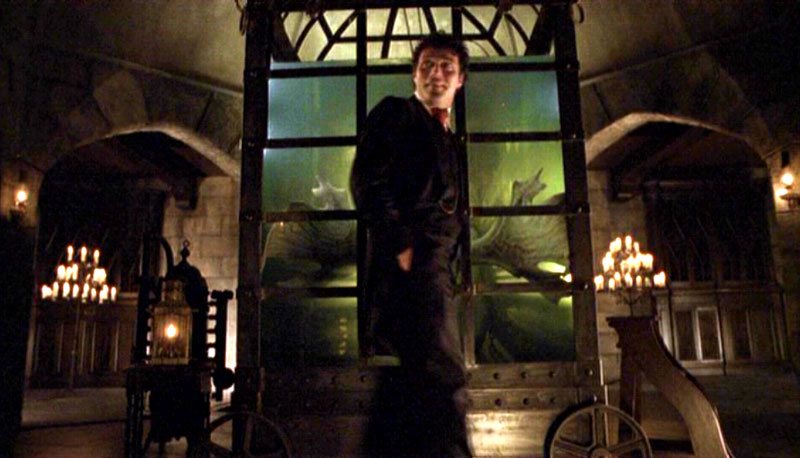
She Creature is set at the turn of the 20th century, and follows the tale of a side show circus that acquires a real mermaid. It starts Rufus Sewell and a bunch of people you almost recognize.
Angus (Rufus Sewell) is the proprietor of the circus, and his lovely lady Lily (Carla Gugino) is the show's mermaid. Of course, hers is just a costume - a hoax like the rest of a circus. But everything changes when Angus and Lily ofter to bring a drunk patron home. Turns out, this drunk guy, actually has a real live, murdering mermaid! Yeah, the mermaid totally ate the drunk's wife. Now he just wants her to die.
Angus can't get the mermaid out of his mind. So he sneaks back to the drunks house and "procures" the creature. Now, the circus is trapped on a boat with a beautiful and deadly mermaid as they cross the Atlantic. But worst of all, Lily seems to have developed a deadly link with the mermaid.
She Creature really creeps me out while being totally awesome, especially for a low-budget film. Lily and the creature are both fascinating strong female characters played by great actresses. The story is solid. The pacing is good. The creature - is totally awesome. The mermaid portrays an inhuman beauty, and the make-up and effects hold up. Plus, she has really nice boobs. Which are everywhere in this movie. I'm sure part of her casting involved how good her boobs look in water.
So, if you're a mermaid fan who can deal with horror movies, you must check out She Creature. It's a lot of fun, and a great creepy take on the myth.
Tuesday, July 3, 2012
Splash into Summer: Part of my World - Creature Creation

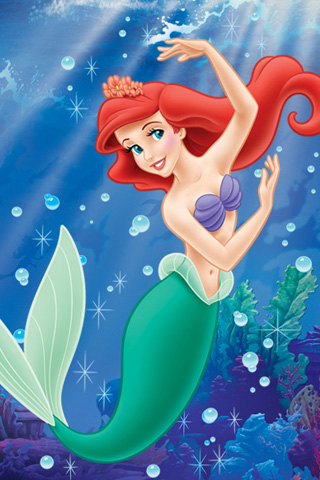
When I decided I wanted to write about mermaids, I knew I didn't want my mermaids to look like this:
I'm not even sure what kind of pose Ariel is doing here.
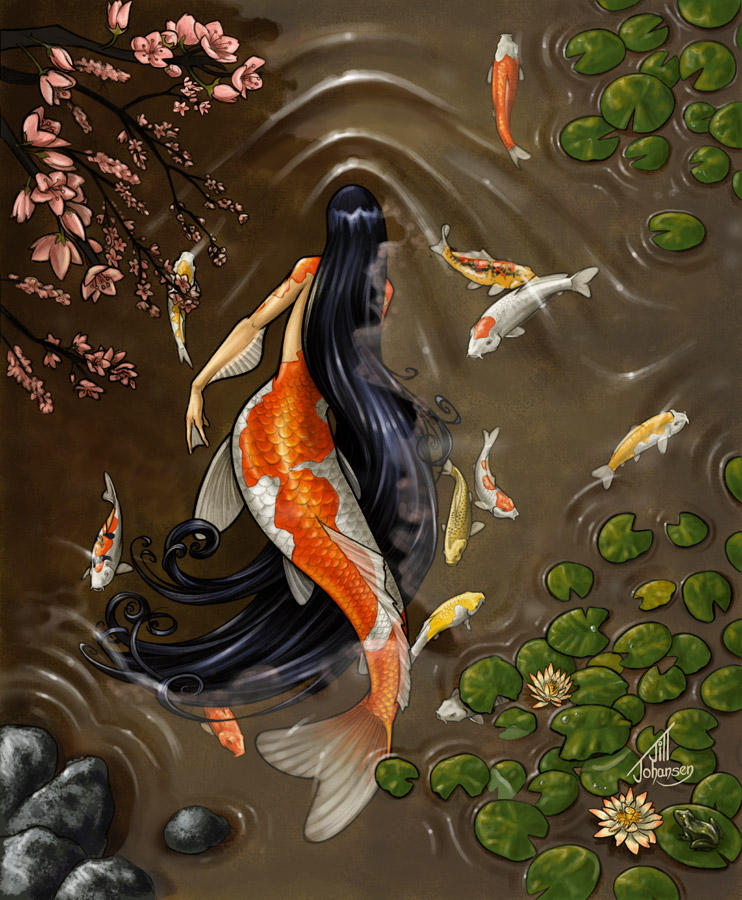
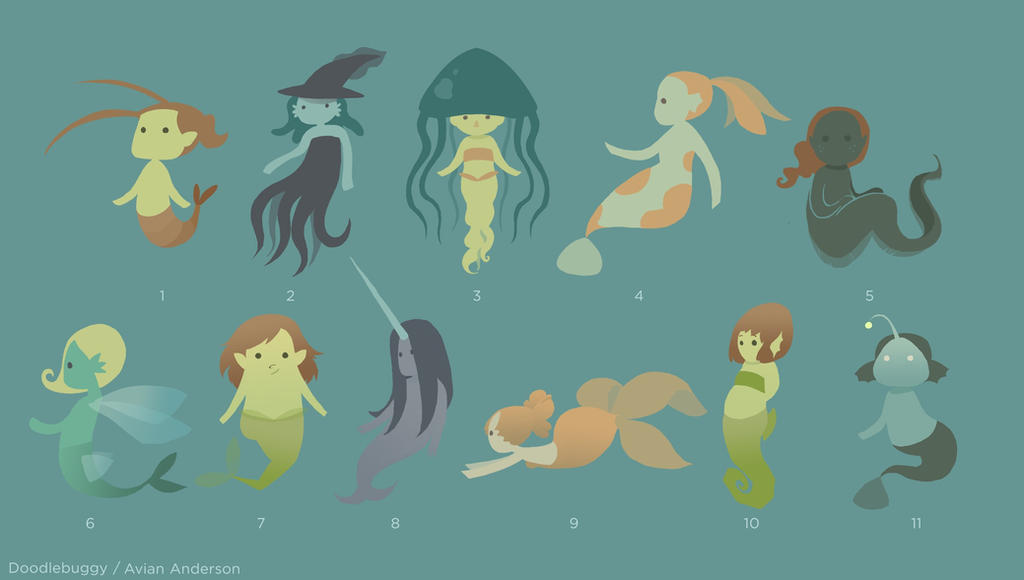
Instead I wanted incorporate my love of saltwater fish into my creatures. I want my mermaids to be based on actual fish.
Ok, so maybe she's based on a koi not a saltwater fish, but you get the idea.
Image by Bamfette
Mermaids aren't an unusual creatures. Their imagery is all over the place, especially around any location that has water. Their image is as iconic as unicorns and fairies. Mermaids are typically visualized as top half very human and bottom generically fishy. Going outside of the box is a glitter tail and gils. Using actual aquatic inspiration for mermaid designs seems rare. I have found some, and they're based on dolphins. (I am not, nor have I ever, been a dolphin person.)
My family has been aquarium hobbyists all my life. In fact, they bread freshwater angelfish on a fairly large scale for a chuck of my childhood. Then when I moved out, I didn't last a year before I bought a betta fish and put it in a giant martini glass.
When I got my first apartment, I set up my first saltwater tank. It was big and I kept lion fish, though I desperately wanted a Harlequin Shrimp.
These are totally my favorite aquatic thing ever! The EAT starfish! How cool is that?
Plus they look like aliens.
Anyway, times pass, and I get this inspiration for writing a mermaid book. Immeadately my years of fishkeeping come to me. I know that my mermaids will take on characteristics of specific fish. Razor fins! Venomous spines! Yes! I start browsing images online, looking for mermaids that resemble mine...
I don't find much.
I start reading more mermaid books to examine how other authors building their creatures and worlds. Still nothing quite like I imagined.
I often feel sad seeing this lack use natural inspiration. Aquatic creatures can be down right cool and weird. They have some of the craziest color combinations on the planet. I knew immeadately, that I would attach a fish inspiration to all of my merfolk. That I would drawn from all my knowledge about cool aquatic creatures. I'll incorporate razor fins and juvenile color patterns.
The Emporer Angel juvinile. My MMC still has this pattern and is teased by his sister for it.
Creature creation is a very difficult part of writing. Mermaids are both over explored and underexplored. The word itself brings to mind a very specific image, yet, it's not the image I want. I'm very excited to mold that image into something new and unqiue. There are so many cool things in nature to take inspiration from. When it comes to mermaids, I want to see this happen.
The Mermaid combinations are endless!
Picture by Doodlebuggy
So, take time to create your creatures. Draw from inspirations you know and love. Google cool pictures and keep a folder. And sometimes, the thing sitting in front of your nose is the best place to start.
Monday, July 2, 2012
Just Keep Swimming

I promise, by the end of this blog, I'll have a Splash Into Summer tie-in.
It's the beginning of July, and the end of Camp Nanowrimo. In case you were wondering, I did not have a miraculous finish. Actually, I'm not even sure of my final word count, but I estimate it's around 30k. I am still okay with this.
This weekend, I've been sitting down with my work, backwards engineering an outline. This is exceptionally rough for me. This draft isn't half bad, but, I'm having a hard time looking at it as a whole. I kept saying, "This writing thing is hard!"
I was feeling particularly down, so I asked Twitter what I should do when it was tough to keep writing. I got the best answer ever.
@MegTao just. keep. writing.
It was the perfect encouragement. Something so simple, how could I have forgotten it? (I'm totally thinking of printing these words out and gluing them to the wall behind my desk. Oh, and check out the awesome MegTao's blog too.)
Then I read this in one of my camp buddies blogs:
"Things Camp Nano Has Taught Me:
...
5.) I will never quit writing."
There's something so profound in that statement that I nearly fell out of my chair.
I will keep writing, and I will never quit.
This totally reminded me of...
Which it totally fishy, and fits right into the Splash into Summer theme! Plus, I'm gonna attempt to post a new post every day for the rest of the week in celebration of Splash into Summer! Booyah!
Tuesday, June 26, 2012
Goals of a Part-Time Novelist
Setting writing goals is essential for being a writer. Goals that are often self induced and self enforced. Be it writing 50k words in a month or #500wordaday, writing regularly is manditory.
This month I opted to partcipate in Camp Nanowrimo, a smaller trafficed but identical competition to Novemember's 50k in 30 days challenge. I went into Camp suspecting I would not complete the 50k challenge, but hoped to get about 30k, or the 1st half of my WIP rewritten, which ever came first.
As June draws to a close, I realize that 50k is not possible for me, but I did achieve my smaller goal. So why do I feel so...unfulfilled?
At some point mid-month, it struck me that I might be able to meet the 50k challenge. I was on target; I was writing daily. What happened?
The realization that I'm only a Part-Time Novelist, for now. I don't have the time between filming and working my real job and spending quality time with my friends and family to spend multiple months of the year writing 50k. The overachiever in me is not happy about that. But I can look back at this month and say, I worked on cleaning (there was much yard work accomplished), I helped with a short film, I didn't call in sick once!, and I rewrote the first half of Tails. That's quite an achievement. I don't feel quite so bad about myself.
So, what am I getting at? We need to remember our priorities. Set goals that are achievable. Lofty goals like 50k in a month or 500 a day are not achievable for every lifestyle. Sometimes 100 words a week is a great goal. Picking something that's reasonable for you is what's important. Then remember to take a step back and look at your accomplishments. Reward yourself when you finish that goal, even if it was a small goal.
While yes, a full time writer can often produce 50k a month without batting an eye, I'm only a part time writer. I'm returning from Camp proudly with half a novel in hand. I think that means a cocktail, and time to finally Splash Into Summer.
Tuesday, June 5, 2012
Researching in Unexpected Places
Camp Nano is overtaking my soul. While I'm so happy to have 10K words worth of revision into Tails (over 5K of that through Camp), having time to go to the movies, read a book, and blog would certainly be nice. So this is my way of saying don't shoot me if I start posting irregularly.
But I have learned my 1st lesson from camp. Research may come from the most unusual places.
Since this is not my first draft, but rather a 2.5 draft that I'm hoping will be completely legible when I'm done. Pausing for research is just as valuable to me as actually writing. So when I hit my first pothole, I calmly a analyzed the best way to fill it in.
One of my characters is fascinated by electric lights. So my description of his fascination can be "ooo! electric lanterns are cool!" No, he has to caress them. Be fascinated by...how the hell do you describe a "lantern"? I think it's time for some research.
A quick google search of lanterns and I can have the whole history of lanterns, but that's not what I need. I need descriptions and diagrams. Where can I find that?
Someplace unexpected: HomeDepot.com
Now, I can look at various shapes and sizes of lamps, and read little descriptions. I found words like flourish, beveled glass, mountings, and fluted details. Words I knew, but would never have applied to a lamp. I also knew what was important when describing it.
I found four lanterns I liked, and using one picture (and inspiration from 4 descriptions), I made my own description:
"He rushed towards the first [lantern] he noticed, dropping Cora’s arm and nearly climbing the wall to get a closer look. He looked at the glowing orb inside like a small sun in captured glass. His hand touched the beveled glass, measuring the heat. A test against the cool flourished Testlite mounting. Cora smiled, proud of her kingdom’s achievements."I had to think outside of the box to get what I needed. Site that sell products are constantly writing descriptions of products - in an informative and marketable way. They make great sources for sticky descriptions, or just to learn terminology about something you're not quite familiar with.
Monday, May 28, 2012
The Social Writer
This year I'm partcipating in Camp Nanowrimo! Yay for me! I'm using the challenge to complete the rewrite (or at least make major headway) of Tails.
Once upon a time, writers were these mythical creatures who carried moleskin notebooks, smoked lots of cigarettes, and hid in dark corners of the world to practice their craft. They talked about the lonely nights of being a writer that non-writers just couldn't understand. It almost seemed as if socializing with other writers would ruin their craft.
Then, something changed. Social media developed and suddenly writers were connecting in more ways then ever. Connecting with readers, agents, publisher, and other writers.
So just maybe, this solitary writing thing is just a myth.
I have always been a social writer. In fact, my NOCCA writing teacher made a comment to me about it. She commented, neither negative nor positive but rather curiously, on how much I interacted with the other students, and how my interaction build a sort of camaraderie. We smiled together, chatted, and met outside of class. Our noses weren't stuck in books or notebooks, but rather talking and observing each other. All of us did just as well as previous classes who secluded themselves.
Perhaps that's why I fell in love with Nanowrimo - I felt connected again.
Having a writing friends is essential to my process. I take comfort in knowing that others are going through the same issues as me. Writer's block? Let's lament over cocktails. Self-pub or traditional pub? Let's debate the pros and cons over coffee. Celebrating finishing that chapter? Doughnuts and critique. Keeping me on track? Peer pressue works better than deadlines.
Throughout collage and when I got back into writing, I did it alone. I had no one to share ideas with or talk plot points out. (My husband often stands proxy, but he is not a writer. Answering if I should use 1st person or 3rd is just something he answers with a blank look.) It was hard. It was lonely. I felt very frustrated.
Then in 2010, I got out of my house and went to a Nanowrimo write-in. In less than two years, I have made some solid friends - friends who won't stare at my clueless when I talk about POVs. Friends that I go to the movies with. Friends that I will ask to critique something when I finally get to that point. It's these people who get me through the tough times. That keep me from giving up. I know that I wouldn't be where I am now without them.
Writing does not have to be a solitary thing (It can be, if that's how you roll.). There are tons of ways to connect: twitter, blogs, Nanowrimo, or local writer's groups. Find one that works for you.
Speaking of connecting, I'll be cross blogging over at the Cabin of the Good Blog - my Camp Nanowrimo Cabin Blog. Check out my specifically Camp vlogs over there.
Yay! Camper Badge.
Getting ready for camp has reminded me of something I really enjoy as a writer - being social. Once upon a time, writers were these mythical creatures who carried moleskin notebooks, smoked lots of cigarettes, and hid in dark corners of the world to practice their craft. They talked about the lonely nights of being a writer that non-writers just couldn't understand. It almost seemed as if socializing with other writers would ruin their craft.
Then, something changed. Social media developed and suddenly writers were connecting in more ways then ever. Connecting with readers, agents, publisher, and other writers.
So just maybe, this solitary writing thing is just a myth.
I have always been a social writer. In fact, my NOCCA writing teacher made a comment to me about it. She commented, neither negative nor positive but rather curiously, on how much I interacted with the other students, and how my interaction build a sort of camaraderie. We smiled together, chatted, and met outside of class. Our noses weren't stuck in books or notebooks, but rather talking and observing each other. All of us did just as well as previous classes who secluded themselves.
Perhaps that's why I fell in love with Nanowrimo - I felt connected again.
Having a writing friends is essential to my process. I take comfort in knowing that others are going through the same issues as me. Writer's block? Let's lament over cocktails. Self-pub or traditional pub? Let's debate the pros and cons over coffee. Celebrating finishing that chapter? Doughnuts and critique. Keeping me on track? Peer pressue works better than deadlines.
Throughout collage and when I got back into writing, I did it alone. I had no one to share ideas with or talk plot points out. (My husband often stands proxy, but he is not a writer. Answering if I should use 1st person or 3rd is just something he answers with a blank look.) It was hard. It was lonely. I felt very frustrated.
Then in 2010, I got out of my house and went to a Nanowrimo write-in. In less than two years, I have made some solid friends - friends who won't stare at my clueless when I talk about POVs. Friends that I go to the movies with. Friends that I will ask to critique something when I finally get to that point. It's these people who get me through the tough times. That keep me from giving up. I know that I wouldn't be where I am now without them.
Writing does not have to be a solitary thing (It can be, if that's how you roll.). There are tons of ways to connect: twitter, blogs, Nanowrimo, or local writer's groups. Find one that works for you.
Speaking of connecting, I'll be cross blogging over at the Cabin of the Good Blog - my Camp Nanowrimo Cabin Blog. Check out my specifically Camp vlogs over there.
Monday, May 21, 2012
Wishes Come True: The Writer's Office
I live in a house of people coming and going. There's usually three to five people (residents or otherwise) and a puppy in my house at any given minute. It's a buzz of activity and creativity. Sometimes, this can be really frustrating to certain creative processes, such as. oh, writing.
It's not so much the noise, but rather, space. For a long while, I had a mini-writing desk/bookshelf/cheap piece of old furniture about three feet in length that was designated "Shannon's writing area." It was a sweet gesture by my husband to carve out a piece of the chaotic filmmaking/arting/writing/editing/acting world that is our house. It worked wonderfully for about...a month. Then it became the place to put all of Shannon's stuff/books/papers/jewelry, and it didn't take long before it was a piece of furniture piled under (more or less) important things of Shannon's.
At the beginning of the year I asked to have the unused upstairs bedroom/unofficially Max's room during the semister. I wanted to make it an office - a place for me to write when the chaos of the house got to be too much. And a place to put my shoes/jewelry/papers/books/craft supplies. I made the request that what I really wanted for my birthday was to have my office set up so I had a place to work on my novel revisions and a place to write for Script Frenzy. My mom came over on weekend to clear out the remaining estate crap in the room (I'm sharing my house with the remaining stuff of my grandmother's - 2.5 rooms of junque). Then, eventually, I bought a can of paint and started painting.
Color Choice: Cheap 80s Sea Foam Green to Plum
Huzzah! New Color, and all crap in the center of the room!
Next was a new desk and to move the bed out of the room and the futon back up. Then it fell into a lull. I started working up here around the piles of crap that needed to be moved/sorted/put away. I struggled to find time between finishing Script Frenzy and editing my library videos to finish straightening up my new office space. So I made a wish to twitter:
"@Secretly_Samus: Can magical office faires and/or elves come and make my office pretty?? #iflifewereafairytale"
Turns out, they were listening.
I come home after a very long day at the 9 to 5 and find this:
And this
Very excitedly, I called all my friends to gush about my awesome new office, which everyone answered with: "About time."
Has having an office been good for my writing? Absolutely. Having my own space (even if it resembles my high school bedroom) has given me a place to focus, to build a routine, and to inform everyone to leave me alone. I've written over 4,000 words in my new space, done a read through of Tails, and created a timeline for my WIP.
Having a space to be yourself and just create is invaluable to any writer, something I knew, but didn't realize until I finally had it. For me, this space is a room dedicated to corkboards and mermaids...
Awesome Mermaid #1 by Jessica Cox
...has really made a difference in my work, my happiness, and my sanity.
So, every writer out there, carve out your writing space and make it yours, wherever that may be. It really makes a difference. And to all of you that already knew this, take a moment to realize how awesome it is to have your own space.
Jessica Cox Mermaid Number 2 (had to have, cuz I love Angler Fishes so much)
Painting I bough from a friend of the family upon completion of Tails in 2009
Monday, May 14, 2012
RIP: Kailyn
So, I'm 1 chapter deep into the new revision of Tails, and I'm already super excited about something. The death of my former female protagonist: Kailyn.
Kailyn, Kailyn, Kailyn, let me count the ways I detest you.
From page 1 of my first draft of Tails (though, it was more like page 5 because Kailyn wasn't in the first page) I detested my romantic interest and female protagonist: Kailyn. She was vapid, whiney, meek, and more a plot device than person. There were things I wanted her to be: smart, resourceful, responsible. Then there was her - a waste of space.
In my numerous drunken rambles about my novel, I would often drone on about how I was going to fix Kailyn. But, really, couldn't figure out how. 'Can you cut her?' No, she's my Male protag's motivation. How can I get rid of her? 'Can you make her less annoying?' If only. I thought, maybe I could minimize her. I'll make her a secondary character, instead of a primary.
I knew the best thing for my novel was to slice off the first 3 chapters and start the book where Kailyn finds a nearly dead Damarion on the beach. One problem - it might lead the focus of the book to be Kailyn instead of Damarion, and I couldn't stand that. So I fussed over the first 3 useless chapters for two months and shelved the WIP.
So, as I sat my my computer throwing bits of 1st draft around like confetti, I started thinking. I have to start the story at that previously mentioned point. Which means I have to deal with my issues with my FMC. But first, a little procrastination. I'm do so much changing (like, solidifing the setting), I thought some characters deserved name changes. And you know what? I never really liked Kailyn for a name anyway.
Five minutes of name research and a list of 10 potential names, and popular vote had a new name for my Female protagonist - Cora. Ah, it brings up thoughts of femme fatales and Lana Turner.
So I started writing, and Cora was doing things. She was smart and quick thinking and a touch rebellious... Before I knew it, I had a new chapter 1 that I was excited about. Then I started thinking about it. Why was it so much easier to write this new chapter 1?
Because Cora is not Kailyn. Cora is everything I wanted Kailyn to be.
Then it came to me - I just cut Kailyn out of the book. But didn't delete the spot, I delted the character, and replaced her with someone better.
So, there's a few lessons I learned from this. 1.) Everything is in a name, and 2.) You can delete a character without deleting a character's role. When I started writing about Cora, I didn't think of her as Kailyn with a new name. Even a new image came to my mind as I was writing. Everything about the character just clicked in my head. Immeadately, I started referring to Kailyn as Cora. The act of changing her name allowed me to change the character because I was no longer thinking of that character. I was thinking of someone new.
And I solved one of my biggest issues with the manuscript by deleting that character I hated withouth deleting the role I assigned her.
So I think a really good trick when you're stuck with a flat character is to change up a name. It worked perfectly for me!
Kailyn, Kailyn, Kailyn, let me count the ways I detest you.
From page 1 of my first draft of Tails (though, it was more like page 5 because Kailyn wasn't in the first page) I detested my romantic interest and female protagonist: Kailyn. She was vapid, whiney, meek, and more a plot device than person. There were things I wanted her to be: smart, resourceful, responsible. Then there was her - a waste of space.
In my numerous drunken rambles about my novel, I would often drone on about how I was going to fix Kailyn. But, really, couldn't figure out how. 'Can you cut her?' No, she's my Male protag's motivation. How can I get rid of her? 'Can you make her less annoying?' If only. I thought, maybe I could minimize her. I'll make her a secondary character, instead of a primary.
I knew the best thing for my novel was to slice off the first 3 chapters and start the book where Kailyn finds a nearly dead Damarion on the beach. One problem - it might lead the focus of the book to be Kailyn instead of Damarion, and I couldn't stand that. So I fussed over the first 3 useless chapters for two months and shelved the WIP.
So, as I sat my my computer throwing bits of 1st draft around like confetti, I started thinking. I have to start the story at that previously mentioned point. Which means I have to deal with my issues with my FMC. But first, a little procrastination. I'm do so much changing (like, solidifing the setting), I thought some characters deserved name changes. And you know what? I never really liked Kailyn for a name anyway.
Five minutes of name research and a list of 10 potential names, and popular vote had a new name for my Female protagonist - Cora. Ah, it brings up thoughts of femme fatales and Lana Turner.
A young Lana Turner would totally make a great Steampunk Princess.
Because Cora is not Kailyn. Cora is everything I wanted Kailyn to be.
Then it came to me - I just cut Kailyn out of the book. But didn't delete the spot, I delted the character, and replaced her with someone better.
So, there's a few lessons I learned from this. 1.) Everything is in a name, and 2.) You can delete a character without deleting a character's role. When I started writing about Cora, I didn't think of her as Kailyn with a new name. Even a new image came to my mind as I was writing. Everything about the character just clicked in my head. Immeadately, I started referring to Kailyn as Cora. The act of changing her name allowed me to change the character because I was no longer thinking of that character. I was thinking of someone new.
And I solved one of my biggest issues with the manuscript by deleting that character I hated withouth deleting the role I assigned her.
So I think a really good trick when you're stuck with a flat character is to change up a name. It worked perfectly for me!
Thursday, May 10, 2012
What I did During Script Frenzy: Library Videos
So, while working on my adaptations for Script Frenzy, I did manage to write, and film 2 short promo videos for the Summer Reading Program at the library I work at. One I finished editing during April, but one didn't get finished until the beginning of May.
I think they're fantastic, considering they were done in about 2 weeks during the Frenzy, and by pretty much me. Those other people, just taking credit. ;)
So, since they're loaded to Vimeo, Blogger won't let me embed them. So here are the links:
Children's Magical Fantasy
Teen's Monster Movie
I think they're fantastic, considering they were done in about 2 weeks during the Frenzy, and by pretty much me. Those other people, just taking credit. ;)
So, since they're loaded to Vimeo, Blogger won't let me embed them. So here are the links:
Children's Magical Fantasy
Teen's Monster Movie
Monday, May 7, 2012
Dilemmas
Anyone following this blog knows that I have been dilligently working on the revision of my 2011 Nanowrimo Novel The Flamingo Princess. Anyone who knows me personally will remember my 1st Nanowrimo when I wouldn't shut up about the mermaid novel I wrote, Tails.
Now, it's time to re-evaluate. I'm seeing a trend forming, for both steampunk and mermaid. I've developed and itch to return to this novel I wrote 3 years ago. But, a part of me really wants to stick it out and finish my WIP.
So, after much dilberation, I've decided to shelve The Flamingo Princess and pick Tails back up. I'll apply my knowledge of revision I've learned this year.
Starting with the read-through.
....
I knew that Tails was a bit of a trainwreck. Three years later, a trainwreck is an understatement. It's basically 50,000 words of me talking out a concept. Info dumps run rampant; characters devoid of personality; and a pacing that would make snails cry. So far the only thing I'm keeping from the draft is the line: The silence between them was heavy like iron. I'm ready to just stop reading, throw the whole draft in the trash, and just start writing from strach.
That would not be the writely thing to do. One thing I've learned from my newly sheleved WIP is the read through is essential.
So, I'm not quiting. My husband has made a very helpful suggestion: record the rest of the book as an audio book, so I can listen to it and stop looking at how awful the writing is. (He's under the mistaken impression that it's not as bad as I say it is.) So, I'm trying that (while secretly rewriting the 1st scene.)
Once it's finished recording, I'll see if I can post some of it here, and report if it was a successful tool for getting me through this first read-through.
The image from my mermaid writing shirt!
Sometime in 2010, Tails and I "broke-up" because I wasn't ready to edit it. I was having so much trouble with the revision (even though I knew I need to chop the first 3 chapters (11,000 words)). Then there was the little fact that in early 2010 no one would have looked twice at a mermaid/fairy tale retelling/steampunk novel. Shelving it seemed like the best idea.
Now, it's time to re-evaluate. I'm seeing a trend forming, for both steampunk and mermaid. I've developed and itch to return to this novel I wrote 3 years ago. But, a part of me really wants to stick it out and finish my WIP.
So, after much dilberation, I've decided to shelve The Flamingo Princess and pick Tails back up. I'll apply my knowledge of revision I've learned this year.
Starting with the read-through.
....
I knew that Tails was a bit of a trainwreck. Three years later, a trainwreck is an understatement. It's basically 50,000 words of me talking out a concept. Info dumps run rampant; characters devoid of personality; and a pacing that would make snails cry. So far the only thing I'm keeping from the draft is the line: The silence between them was heavy like iron. I'm ready to just stop reading, throw the whole draft in the trash, and just start writing from strach.
That would not be the writely thing to do. One thing I've learned from my newly sheleved WIP is the read through is essential.
So, I'm not quiting. My husband has made a very helpful suggestion: record the rest of the book as an audio book, so I can listen to it and stop looking at how awful the writing is. (He's under the mistaken impression that it's not as bad as I say it is.) So, I'm trying that (while secretly rewriting the 1st scene.)
Once it's finished recording, I'll see if I can post some of it here, and report if it was a successful tool for getting me through this first read-through.
Subscribe to:
Posts (Atom)