Showing posts with label rewriting. Show all posts

Monday, July 23, 2012

Perspective

Perspective of yourself and your work is often the hardest part of being a writer.

For the last two weeks I've been meticulously stressing over details of my WIP. I'm not even talking about word choice (I won't even let myself go there yet.). I'm constantly doubting, and second guessing my choices. Should I pick one central protagonist? Or push forward with my feeling that there are two? Are their POVs balanced? Is my setting developed? Do I have to many additional characters? Are my main protagonists fleshed out enough? Is the romance even working?

One corkboard of index cards later, I knew I needed a new perspective.


A lot of writers recommend taking a break. Taking time off from the story. This isn't always the solution for me. When I first wrote this manuscript nearly 3 years ago, I had to put it down for some of the very same issues I'm fretting over now. If 3 years isn't enough shelf time to separate myself from these issues, no amount of time will be.

When I talk to some of my friends, they're advice is to just keep writing. Keep telling the story and worry about that during revision. Well this is revision. I have the story done. I'm trying to iron out kinks. Smooth over the rough draft. What is there to keep writing? AHG!

So I did something different. I sucked it up and sent the mess of a 3rd draft to some alpha readers - the lovely ladies I met through Camp Nano in July. Many of us writers have heard of beta readers, those wonderful critiquers who point out all the plot holes so we can cement them in. A beta reader should only be reading a draft once you've reached the point where you can see nothing wrong. A alpha reader is more or less someone who can keep you on track. Someone to run a messy draft, a preliminary idea by, that will let the writer know if she's on track or not. They offer general ideas and suggestions, knowing you're probably aware of the nitty gritty of revision you still have to complete.

So far, it has given me some perspective. I'm clearly worrying about POV entirely too much. I'm trying to pit all the rules of writing I've been taught against my storytelling instinct. Letting others read it is allowing me to get over that hurdle. Yes, my story can be successful while having 2 POVs.

Instead I know I need to focus on some world-building and exposition. Make sure all my plants are in place and clear. These are things I thought I had succeeded at, but, I hadn't.

Writing cannot be a solitary art form. This is in part due to the fact that in order to be a novelist, you need readers. I mean that's the point isn't it? The writer has a story to tell, but she needs the reader to hear it. Writing is the the medium of expression.

Locking myself up in my office and obsessing over details and lessons was becoming detrimental not only to my story, but to my mental state. I felt lost and hopeless, and all my confidence in my project ptttph out like a deflating balloon. I needed that outside prospective to keep me on track.

And this Panic! At the Disco Song to jam out to.

Tuesday, June 26, 2012

Goals of a Part-Time Novelist


Setting writing goals is essential for being a writer. Goals that are often self induced and self enforced. Be it writing 50k words in a month or #500wordaday, writing regularly is manditory.

This month I opted to partcipate in Camp Nanowrimo, a smaller trafficed but identical competition to Novemember's 50k in 30 days challenge. I went into Camp suspecting I would not complete the 50k challenge, but hoped to get about 30k, or the 1st half of my WIP rewritten, which ever came first.

As June draws to a close, I realize that 50k is not possible for me, but I did achieve my smaller goal. So why do I feel so...unfulfilled?

At some point mid-month, it struck me that I might be able to meet the 50k challenge. I was on target; I was writing daily. What happened?

The realization that I'm only a Part-Time Novelist, for now. I don't have the time between filming and working my real job and spending quality time with my friends and family to spend multiple months of the year writing 50k. The overachiever in me is not happy about that. But I can look back at this month and say, I worked on cleaning (there was much yard work accomplished), I helped with a short film, I didn't call in sick once!, and I rewrote the first half of Tails. That's quite an achievement. I don't feel quite so bad about myself.

So, what am I getting at? We need to remember our priorities. Set goals that are achievable. Lofty goals like 50k in a month or 500 a day are not achievable for every lifestyle. Sometimes 100 words a week is a great goal. Picking something that's reasonable for you is what's important. Then remember to take a step back and look at your accomplishments. Reward yourself when you finish that goal, even if it was a small goal.

While yes, a full time writer can often produce 50k a month without batting an eye, I'm only a part time writer. I'm returning from Camp proudly with half a novel in hand. I think that means a cocktail, and time to finally Splash Into Summer.

Tuesday, June 5, 2012

Researching in Unexpected Places


Camp Nano  is overtaking my soul. While I'm so happy to have 10K words worth of revision into Tails (over 5K of that through Camp), having time to go to the movies, read a book, and blog would certainly be nice. So this is my way of saying don't shoot me if I start posting irregularly.

But I have learned my 1st lesson from camp. Research may come from the most unusual places.

Since this is not my first draft, but rather a 2.5 draft that I'm hoping will be completely legible when I'm done. Pausing for research is just as valuable to me as actually writing. So when I hit my first pothole, I calmly a analyzed the best way to fill it in.

One of my characters is fascinated by electric lights. So my description of his fascination can be "ooo! electric lanterns are cool!" No, he has to caress them. Be fascinated by...how the hell do you describe a "lantern"? I think it's time for some research.

A quick google search of lanterns and I can have the whole history of lanterns, but that's not what I need. I need descriptions and diagrams. Where can I find that?

Someplace unexpected: HomeDepot.com

Now, I can look at various shapes and sizes of lamps, and read little descriptions. I found words like flourish, beveled glass, mountings, and fluted details. Words I knew, but would never have applied to a lamp. I also knew what was important when describing it.

I found four lanterns I liked, and using one picture (and inspiration from 4 descriptions), I made my own description:


"He rushed towards the first [lantern] he noticed, dropping Cora’s arm and nearly climbing the wall to get a closer look. He looked at the glowing orb inside like a small sun in captured glass. His hand touched the beveled glass, measuring the heat. A test against the cool flourished Testlite mounting. Cora smiled, proud of her kingdom’s achievements."
I had to think outside of the box to get what I needed. Site that sell products are constantly writing descriptions of products - in an informative and marketable way. They make great sources for sticky descriptions, or just to learn terminology about something you're not quite familiar with.

Monday, May 14, 2012

RIP: Kailyn

So, I'm 1 chapter deep into the new revision of Tails, and I'm already super excited about something. The death of my former female protagonist: Kailyn.

Kailyn, Kailyn, Kailyn, let me count the ways I detest you.

From page 1 of my first draft of Tails (though, it was more like page 5 because Kailyn wasn't in the first page) I detested my romantic interest and female protagonist: Kailyn. She was vapid, whiney, meek, and more a plot device than person. There were things I wanted her to be: smart, resourceful, responsible. Then there was her - a waste of space.

In my numerous drunken rambles about my novel, I would often drone on about how I was going to fix Kailyn. But, really, couldn't figure out how. 'Can you cut her?' No, she's my Male protag's motivation. How can I get rid of her? 'Can you make her less annoying?' If only. I thought, maybe I could minimize her. I'll make her a secondary character, instead of a primary.

I knew the best thing for my novel was to slice off the first 3 chapters and start the book where Kailyn finds a nearly dead Damarion on the beach. One problem - it might lead the focus of the book to be Kailyn instead of Damarion, and I couldn't stand that. So I fussed over the first 3 useless chapters for two months and shelved the WIP.

So, as I sat my my computer throwing bits of 1st draft around like confetti, I started thinking. I have to start the story at that previously mentioned point. Which means I have to deal with my issues with my FMC. But first, a little procrastination. I'm do so much changing (like, solidifing the setting), I thought some characters deserved name changes. And you know what? I never really liked Kailyn for a name anyway.

Five minutes of name research and a list of 10 potential names, and popular vote had a new name for my Female protagonist - Cora. Ah, it brings up thoughts of femme fatales and Lana Turner.
A young Lana Turner would totally make a great Steampunk Princess.

So I started writing, and Cora was doing things. She was smart and quick thinking and a touch rebellious... Before I knew it, I had a new chapter 1 that I was excited about. Then I started thinking about it. Why was it so much easier to write this new chapter 1?

Because Cora is not Kailyn. Cora is everything I wanted Kailyn to be.

Then it came to me - I just cut Kailyn out of the book. But didn't delete the spot, I delted the character, and replaced her with someone better.

So, there's a few lessons I learned from this. 1.) Everything is in a name, and 2.) You can delete a character without deleting a character's role. When I started writing about Cora, I didn't think of her as Kailyn with a new name. Even a new image came to my mind as I was writing. Everything about the character just clicked in my head. Immeadately, I started referring to Kailyn as Cora. The act of changing her name allowed me to change the character because I was no longer thinking of that character. I was thinking of someone new.

And I solved one of my biggest issues with the manuscript by deleting that character I hated withouth deleting the role I assigned her.

So I think a really good trick when you're stuck with a flat character is to change up a name. It worked perfectly for me!

Monday, May 7, 2012

Dilemmas

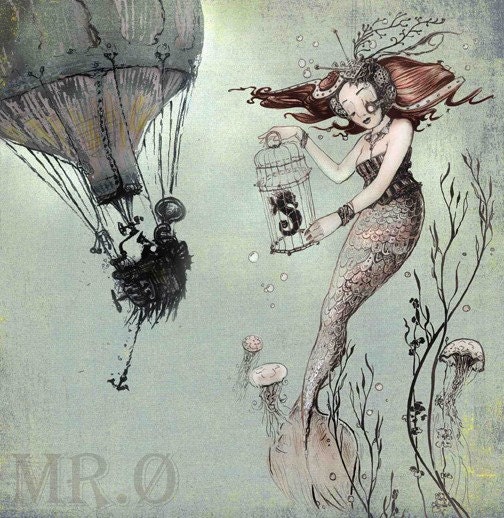
Anyone following this blog knows that I have been dilligently working on the revision of my 2011 Nanowrimo Novel The Flamingo Princess. Anyone who knows me personally will remember my 1st Nanowrimo when I wouldn't shut up about the mermaid novel I wrote, Tails.
The image from my mermaid writing shirt!
Sometime in 2010, Tails and I "broke-up" because I wasn't ready to edit it. I was having so much trouble with the revision (even though I knew I need to chop the first 3 chapters (11,000 words)). Then there was the little fact that in early 2010 no one would have looked twice at a mermaid/fairy tale retelling/steampunk novel. Shelving it seemed like the best idea.

Now, it's time to re-evaluate. I'm seeing a trend forming, for both steampunk and mermaid. I've developed and itch to return to this novel I wrote 3 years ago. But, a part of me really wants to stick it out and finish my WIP.

So, after much dilberation, I've decided to shelve The Flamingo Princess and pick Tails back up. I'll apply my knowledge of revision I've learned this year.

Starting with the read-through.

....

I knew that Tails was a bit of a trainwreck. Three years later, a trainwreck is an understatement. It's basically 50,000 words of me talking out a concept. Info dumps run rampant; characters devoid of personality; and a pacing that would make snails cry. So far the only thing I'm keeping from the draft is the line: The silence between them was heavy like iron. I'm ready to just stop reading, throw the whole draft in the trash, and just start writing from strach.

That would not be the writely thing to do. One thing I've learned from my newly sheleved WIP is the read through is essential.

So, I'm not quiting. My husband has made a very helpful suggestion: record the rest of the book as an audio book, so I can listen to it and stop looking at how awful the writing is. (He's under the mistaken impression that it's not as bad as I say it is.) So, I'm trying that (while secretly rewriting the 1st scene.)

Once it's finished recording, I'll see if I can post some of it here, and report if it was a successful tool for getting me through this first read-through.

Monday, February 20, 2012

Killing Darlings


Sometimes, I think being stuck at my day job, unable to write, but thinking about writing, might be the best thing for revision. It has lead me to a solution I had been struggling with, and I believe I have come to the point where I slay my first darling. Her name is Celeste.
"Kill your Darlings" is a writing term (though, I heard if first during a screenwriting class) that describes eliminating or cutting something from a work that the writer is close to for the improvement of the work. There's a debate by who actually coined the term, but a couple of famous people have been quoted about it.
I generally don't have a problem with this removal of an element that I'm close to. I think it's the filmmaker in me (where I'm on set and there's not more time or budget left and it's only the essentials we film). So, when looking at my draft after the first read through, I knew I needed to get rid of my beloved Celeste. I just couldn't figure out how.
I never thought that I had a problem killing my darlings. I always found it easy to drop various elements of my story, even if I was emotionally attached to them. That is, if there was a reason for it. Yet, Celeste, well, she snagged me.
Celeste was one of the characters I wrote the story for. She's the herione (though is she really?) from the Grimm Tale "Sweetheart Roland." That tale has resounded with me since the Third Grade because I always thought that the herione was the stupidest girl on the planet. One of subplots I wanted to include in my Flamingo Princess was a reworking of the end of "Sweetheart Roland." One in which the herione is not totally screwed over and calls out Roland on in his infidelity. So I wrote it; it was a cruitial plot point of the novel.
After my first read through, I realized that Celeste fell to the wayside for a good two thirds of the book, only appearing in the beginning and for her big scene. Her character was a bit boring and whiney, which made her climax seem unnatural. Many of her earlier scenes felt forced - I was pushing her there so she could have her big scene. I mean, really, did she have to go to the Cinderella ball? No! I just needed some reason to keep her around... But something, something crutial happens during her big scene, making cutting her completely quite hard. If I deleted her big scene, well, then the charcters wouldn't reach the end.
If that's the case, then is this a darling I really should kill? The answer: yes.
As I work over my beginning, filling in the holes, I kept trying to figure out how to incorporate Celeste more. If I made the character more prevalent, then I don't have to cut her! Yeah, right.
Then I realized how to solve my problem. With a few tweaks, Celeste's big scene could become another character's big scene - someone who was left unresloved in the book anyway. Someone who kept stealing the scene from Celeste, filling her void anyway. There could be only one. Celeste then vanishes from the pages of my book like a wisp of smoke and none would be the wiser.
And I feel - relieved. I think Celeste was weighing me down. She didn't fit into this story, and someday, I'll revisit her and give her a story of her own. Plus, it solves another plot problem I'd been having.
So why did it take me so long to kill her? I think it was because a part of me didn't want to lose her. Her subplot is something I've wanted to explore since I was in third grade. She was a major inspiration for writing the book. I think a part of me didn't want to figure out how to shift things and eliminate her because if she was so important to me, she had to be that important to the story. Instead of trying to figure out how to work her back in, I should have been trying to figure out how to work her out completely.
We need to trust our guts. If our instinct is whispering "kill that darling" we need to listen. That's not always so easy because often we can rationalize to ourself why we shouldn't.
I think to make up for it, I'll leave Celeste in my special thanks when I get the book published.

Monday, February 13, 2012

Filling in the Holes

Ok, so I'll be honest - I'm terrible at outlining. I have managed to get a real basic outline done. All cruicial plot points are noted and most characters catalouged. I wanted to do something more detailed, but, I can't. It's not in me.
So on to the next step: Filling in the Holes.
As I went back through my piece, I eliminated entire sections (and the entire beginning). Chapters 1-3 ended up in the trash with little notes about what new events chapter 1-3 could be. I didn't think the book could just start with chapter 4, but actually just needed a whole new method for how to get to chapter 4.
This means there's lots of little gaps to fill. Finally something fun.
Why is it fun? Because it means writing freely! (At least, mostly.)
Unlike my original drafting process for this novel (which was make it up as I go), I did outline what my gaps would be filled with. I know that Chapter 2 Scene 2 West climbs a apple tree in an orchard while the Fox he met steals his bow. Of course, while I can describe the entire scene is a sentance, I'll need a few more to make it a whole half of a chapter.
Like my original draft though, I'm just going through and writing the scenes. I'm not fussing with them to make them look sparkley and polished. Because, when I start looking through the book again, maybe these new scenes won't be what I needed. So if I spend all that time making them look sparkely, then that's a lot of time wasted.
So, the next step in the revision process is - write all the new scenes needed to fill in holes. Let's see how it goes!

Monday, February 6, 2012

Back to Basics - an Ephinony


I have been struggling with getting my plot in order. I have it sort of mapped out, but, as much as I love structure, outlining is something I'm terrible at.

I understand where beats go, and what's suppose to happen when. I really do, but when trying to apply that to my work, it's like herding cats. Difficult and full of little claws.

A book about plot passed by me at work, so I stopped to read the first chapter. I didn't think I was going to learn anything new from reading the first few pages of this book, but I'm always willing to learn something new so I gave it a shot.

Or maybe just get inspiration.

As I was reading the book, I realized that I had forgotten the basics. Years and years of study of the craft and I forget my foundations because I'm so worried about alliteration. Step one of writing a book: Who's your main character and what's their motivation. How could I have forgotten that?

Halfway through writing my first draft I realized that my original MC (The Flamingo Princess - a spunky girl who'd been a flamingo for quite some time, and had become comfortable in her skin) wasn't actually the MC. It was West, originally a side character who acted as the catalyst for change in my flamingo's life. He undergoes the most character change throughout the piece, and I knew then, that this was actually his story. So, when I went to rewrite, I knew I was going to drop some scenes to focus more on him.

But when looking at my plot, I kept feeling overwhelmed and dazed. I didn't know what scenes were missing, and which ones to cut. Who to cut out and who to leave. How to change this to West's story. Because I never thought of it in terms of my MC's motivation.

West wants to go home. Why can't West go home? Because his father kicked him out, and he has to return with a knight's reputation. So, if West wants to get home, now I can look at every conflict as "How is this preventing West from getting home?"

Bingo. I feel like I found the missing link.

As much as we write and rewrite, it's important to always remember the basics. This is perhaps the easiest thing to forget.

So, early in the revision process (before going back and outlining) we need to state: who is this story about and what does he/she want? Then we can look at every scene and say "How is this scene helping/hindering that goal?"

Monday, January 23, 2012

Revision is Hard - The Right Tool

Revision is hard, and Scrivener is awesome.

In my last revision post, I mention it was time for me to do something most writer's do befoer they write - outline. So I took a little notebook and wrote a small summary of every chapter of my book down. I also took any notes about new scenes and put them into this new outline as well as deleted scenes that weren't important. Then, I spent a week trying to look at those pages in that little notebook as a whole story.

And that's really hard. I got so frustrated with trying to figure out if I wrote enough details down. Trying to see the holes in the story that I knew were there. I needed a better way of looking at outline, and a little birdy told me to pull out my handy dandy Scrivener.

I could write a whole ode to Scrivener (because I love this program), but I'll stick to talking about what I'm doing with it. I pulled out my copy and realized that I need to update. A major update that was going to cost me $20 bucks. Well, with Christmas just passing and my health insurance sucking, I couldn't afford that week. So I almost let my story lapse. (And I'm sure I'll soon write about avoiding procrastination, because that's sort of what this was.)

But I wouldn't let myself lapse, so I did something new, I rewrote the first scene of the book incorporating some of the changes I knew I wanted to make. It might have only been about 300 words, but it helped pass the time until I could get the $20 bucks to upgrade Scrivener.

And thank god I did. The layout of Scrivener is just what I needed to look at my story a little better. Which leads me to the point of this blog, know what tools work best for you.

Once upon a time, I wrote everything long hand. I swore by long hand. Then Nanowrimo came along and long hand can be the kiss of death. Yet, because of my history with long hand, I returned to it for this revision. Turns out it wasn't working for me - at least not like I wanted it to. Since I've been writing digitally, I need something digital. Scrivener fit the bill.

Everyone is going to have different preferences on what tools they need. But having a good tool is a great resource to sticking on track with revision. For me, that tool is Scrivener. But I think it's important for writers to mess around with all sorts of tools. Finding something that helps in the revision process is priceless, so download that free trial and see what's out there!

Friday, January 20, 2012

Short Story: Amphibious


So, yesterday marked the beginning of the voting period for Figment Fiction's Cinder short story contest. My entry "Amphibious" is up, so if you like my blog, head over and read it.

I have two reasons for my shameless self promotion:

1. Maybe you'll heart it, because, well, I want to win.

2. I'm putting my money where my mouth is so to speak.

Many of you readers have not read any of my work, so you may wonder, how I can be any authority on anything. Well, this does prove I write, and you can sort of gague my skill. And I know that if I were you I'd be interested in seeing what I write.

And as a bonus, I get to talk a little about my process for this story.

"Amphibious" is a short, horror/sci-fi story retelling the "Frog Prince." It's actually an idea I've had floating in my head for a few years now, orginally as a short film. Well, I never made it as a short film, and my film team never seemed to be interested in it. So when I saw the Cinder genre mash-up contest, I figured, what the hell.

Interestingly, I always imagined the main character (May) being a professor. But when I saw the challege was more for the young adult crowd, I tried to see if there was anyway to make May younger. She knew her boyfriend/fiance wasn't talking to her (via a ring), so her engagement ring became a class ring. I knew I wanted to mention the glowfish, and originally May was telling a student those facts, but it became May learning about those facts. I was really surprised at how easily all my points could be swaped for a younger protagonist (which actually makes the story more gruesome).

I started writing this maybe a week and a half ago. It went though 4 to 5 revisions. The first revision involved any major plot changes (such as the ending). The second revision was to make sure I didn't skip any details and I foreshadowed anything of importance. Revisions three through five were mostly line edits. I wanted to make sure everything was clear, and that I used the best words I could think of. Hmmm, this is probably a map for what I'll need to do with my novel...

Honestly, I wish I had more time for revision. While I like the story, I still think it could use some more work. But, feel free to read it, critique, tell me if you love it or hate it, ease your curisoity, etc. And enjoy!

Monday, January 9, 2012

My Prior Revision Attempts and The Wait


Until 2009, I'd always revised as I went. Of course, I mostly wrote short stories. In short stories it's easy to get away with revising as you go because, well, they're short. Until Nanowrimo 2009, I'd never managed to complete anything longer than a short story because, well, I was revising as I went. I'd write about one to three chapters, spend hours and weeks tweaking and perfecting them, get distracted and leave the piece alone - never to return.

So, in November of 2009, I managed to shut away that editor for a month and get my first major draft done. Something I'd never done before (though not from lack of trying).

So my first generality of revision for anything longer than ten pages is: do not revise as you go. It really, really doesn't work.

Which brings me to the first revision rule of thumb I've heard over and over - get some distance or "The Wait."

Getting distance from the first draft is suppose to be crucial to revision because I can come at my piece with less bias. The way to achieve this distance is with time - "The Wait." Let your book sit and stew for a while. Depending on who you ask, the time in "The Wait" varies, but going by another rule of thumb, it's about a month.

So upon completing my 2009 draft, I knew I needed "The Wait" to get some perspective, though I was itching to get my hands on the piece and get into it.

Well, I waited somewhere between four and six weeks, a little over a month. My enthusiasm for piece dwindled, but I was determined to work on it. So I tired. And I tired. And I rewrote Chapter One, and wondered if I needed to change main characters, and if I should really start at Chapter Four, and if I should pull all my hair out because my female protagonist was annoying...

Needless to say, I fell "out of love" with that book and shelved it.

Enter November 2010. I have a new idea based on some old characters. I get the draft down, and all the while I keep thinking, hey, I've really got something going here! This book is completely marketable, and it's new and interesting! But it's going to need some revision.

So I followed that rule of thumb, but thought, maybe I was a little too soon with 2009's novel, so I'm going to wait a little longer on this one. Get some more distance and perspective. Oh, let's say, three months! Because if one month is suppose to be good, then three months should be better!

I think I got as far as revising the first line, and that was about it.

Well, November 2011 is wrapping up and I'm really really itching to start revising - mostly because I wrote this entire book without knowing where it was going at all. So by the time I reached the end, I knew that the beginning was going to need work. And I was really curious to see if all these connections I thought I'd made really were as awesome as I thought they were!

But that little voice was telling me "you need to wait."

Then another voice was saying, "has waiting really helped you?" The answer - not really.

Well, I knew that the first thing I wanted to do was print the whole thing out (because I wanted to slash some of those scenes I knew where dragging on too long, or were totally useless, and basically, the first 30 pages). It would feel so wonderful just x-ing through pages! I mean that's revision right?

Well, my printing plans didn't go quite as quickly as I'd hoped. It took me two weeks to get the thing printed, and I think, that was the perfect amount of time for me. Which leads me to my thoughts on "The Wait."

Yes, we do need to distance ourselves from our work so we can come at it with fresh eyes. We need to forget the beginning so we can really see how it relates to the end, which is what "The Wait" does. But, how long we need to wait is going to vary. I think my earlier problems was I was waiting too long. I have a buzz, an energy after finishing a draft that keeps me involved in the story, and that by waiting, I was allowing other things to take control of that energy, so when I finally made it back to my writing, I'd lost interest. I really had fallen out of love with my piece. I need to keep that love to continue working.

So I'm going to venture out and say there shouldn't be any sort of set time for "The Wait," but should be like a weekend away from a lover - just long enough to miss it, but not long enough to forget. For me, that was two weeks. For some it could be two months, or even two years. But when you start to feel that spark for the book fade, that means you need to stop "Waiting" and start rewriting.

Sunday, January 1, 2012

Why a Blog on Rewriting

The other night I was at Friday's restaurant, enjoying happy hour dollar off cocktails and half off appetizers, in celebration of a promotion at my day job with a writer friend of mine. So of course, the subject inevitably led to writing.

We'd met during Nanowrimo, and being as it was the end of December, we were both talking about what we were going to do with our Nano Novels over the next year.

Two years ago I promised myself that in three years I would have a completed manuscript so I could start really looking into getting published. Instead, I've written three first drafts and done absolutely nothing with them. Well, nothing of use. Until about a week ago.

I started reading through my 2011 Nanowrimo Novel. My first step to actual revision.

I was so proud that I've actually managed to start revising a project, that it got us on to the epic discussion of revision.

And the epic lack of materials about revision.

I mean, if I want to write a first draft, there are endless books and general truths out there regarding it. If I'm looking for publishing information, well, there's oodles out there too, as well as even more general truths about how to do it. If I'm looking for tips about writing in general, there's even more on that!

But if looking for something in between, that magic way to get from first draft to something ready to submit to an agent, the horizon is surprisingly quiet. Is everyone afraid to talk about that next step? Is it because it's hard to define, or because we're afraid as writers that if we release that secret, we'll only add more competition?

The subject of revision seems to be this: it's what you do after your first draft, what you need to do before you publish, and completely different for everyone.

Somehow I doubt that.

I mean, there is some really good advice out there regarding writing that first draft like, write all the way through. Kind of a general truth there. Or you know, working out how a story is structured with a little outlining work. But when we get to the finished the draft, now what? stage, everyone gets silent. I mean, there has to be some universal truths out there that can at least help me get on the right path with this.

But everything I read just seems to gloss over it (or be a companion manual to a drafting book that if I didn't follow the drafting process doesn't make sense because I didn't fill out form A).

Well, it's a new year, and I'm going to make a resolution to write about my revision experience so that others like me might have some guidelines to follow. And it might keep me on the revision train. I'll talk about what I'm doing, what's working, and what's not working.

I can't guarantee that I'll be regular with this blog, because well, rewriting isn't the most scheduled thing. Still, I welcome all writers, of all genres, shapes, and sizes to follow along, question, and comment during my next year of revision. I want to make this a learning experience for everyone.